 Age I · ca. 1.4 Ma – 130,000 years ago
The Human Dawn in Iberia
Orce (Barranco León, Fuente Nueva 3), the 'Pink' face from Sima del Elefante, Homo antecessor, Sima de los Huesos, the Acheulean world, and the mastery of fire.

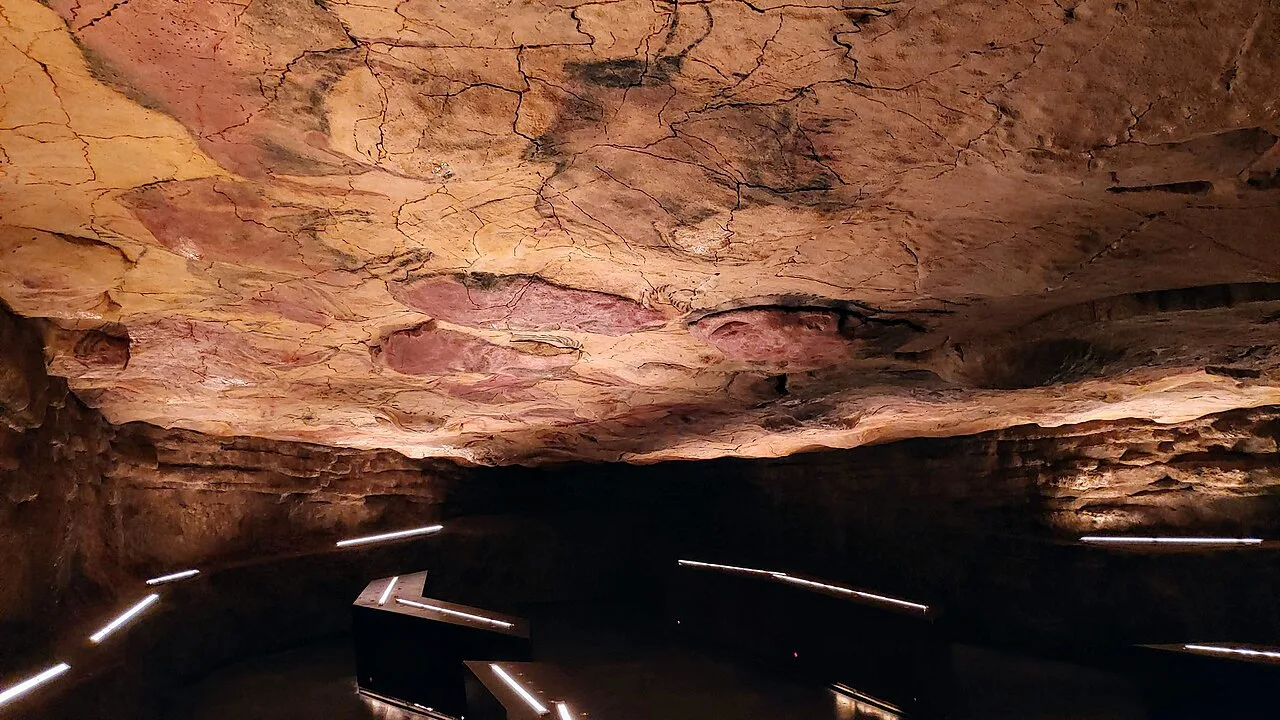
Journey across nearly one and a half million years with scientific rigor and clear prose: from the pioneers of Orce and Atapuerca and 57 rock art caves to the oppida of the Carpetani and the Roman conquest of the 1st century BCE.
Starting from our Main Guide, each age unfolds into a complete, accessible monograph backed by scientific sources and direct links to caves, sites, and museums.
Age I · ca. 1.4 Ma – 130,000 years agoOrce (Barranco León, Fuente Nueva 3), the 'Pink' face from Sima del Elefante, Homo antecessor, Sima de los Huesos, the Acheulean world, and the mastery of fire.
 Age II · ca. 130,000 – 40,000 years ago
Homo neanderthalensis, Levallois flaking, El Sidrón, Pinilla del Valle, the Gorham's Cave engraving, and the U-Th dating debate (>65,000 years ago) at La Pasiega, Maltravieso, and Ardales.
 Age III · ca. 41,000 – 10,500 years ago
Homo sapiens: Aurignacian to Magdalenian, the 38 Paleolithic caves of Spain and Portugal (Altamira, Tito Bustillo, Ekain, Reguerillo, Cova Dones), pigments, lighting, and conservation.
 Age IV · ca. 10,500 – 800 BCE
Agricultural revolution, megalithism, Levantine and Schematic Art (Cogul, Araña, Galería del Sílex), Los Millares, Bell Beaker, El Argar, and the Cogotas I Horizon.
 Age V · 9th – 3rd centuries BCE
Phoenicians, Tartessos, Greeks, pre-Roman peoples, and the full monograph of the Carpetani: Tagus oppida, salt flats, Titulcia Patera, Illescas Relief, and pantheon.
Age VI · 237 BCE – 1st century BCEBattle of the Tagus against Hannibal, Second Punic War, Roman conquest of Toletum, treaties of Gracchus, Viriathus, Numantia, Sertorian Wars, museums, and classical sources.
Ages IV, V & VI · From Cogotas I to the 1st century BCE
From Late Bronze Age roots (Cogotas I) to the great fortified oppida of the middle Tagus valley (El Llano de la Horca, Titulcia, Complutum, Caraca, and Toletum), our full narrative traces how the Carpetani confronted Hannibal in 220 BCE and integrated into Roman Hispania.
“The Relief of El Cerrón de Illescas is carved in stone.”
Reality: It is modeled in terracotta (fired clay) measuring 1.35 × 0.33 m and decorated a 4th-century BCE ritual bench-altar.
Museum of Santa Cruz (Toledo) · Age V“Ochre could only stick using complex recipes of egg, blood, and resin.”
Reality: In most cases, calcium-rich cave mineral water alone was enough to bind iron oxides into the limestone pores.
Cave Atlas · Age III“Ataecina and Bandua formed the core pantheon of Carpetania.”
Reality: Their cults belong to the Lusitanians and Vettones. In Carpetania, Togo, Airón, the Nymphs, the Matres, and Epona stand out.
Salinas de Frías; Almagro-Gorbea · Age VInstantly check which rock art caves (57) and archaeological sites (129) are open to visitors, where to buy official tickets, and which museums or replicas to visit.
Full-scale scientific replica in Santillana del Mar to experience the Magdalenian ceiling without harming the original.

Regulated visits in Ribadesella alongside an essential Rock Art Center in eastern Asturias.

The exact replica of the sanctuary of horses in Zestoa with hands-on workshops on fire, flint, and pigments.
Titulcia Patera, El Llano de la Horca, Complutum, Caraca, the National Archaeological Museum, and Santa Cruz Museum.