
Table of contents for this page
- General summary by Ages and direct links
- 0.0 Introduction: A bridge of rock, water, and memory at Europe's edge
- The scientific revolution that has rewritten our past
- Age I · The Human Dawn in Iberia: Early and Middle Pleistocene (ca. 1.4 Ma – 130,000 years ago)
- 1.1 The Pioneers of Orce and the Guadix-Baza Basin (ca. 1.4 – 1.2 million years ago)
- 1.2 The Sierra de Atapuerca: A Million-Year Archive in Burgos
- 1.3 The Acheulean Revolution, Mastery of Fire, and the Great Rivers of the Meseta
- Sources and References for Age I
- Age II · The Neanderthal World and the First Symbols: Middle Paleolithic (ca. 130,000–40,000 years ago)
- 2.1 Masters of stone, wood, and the sea: the Mousterian culture
- 2.2 Major Neanderthal sites across the Iberian Peninsula
- 2.3 The birth of underground art and the great scientific debate
- 2.4 The Ebro frontier, interbreeding with Homo sapiens, and the end of an era
- Sources and references for Age II
- Age III · The Golden Age of Caves: Upper Paleolithic (ca. 41,000–10,500 years ago)
- 3.1 Daily Life of Homo sapiens in the Ice Age
- 3.2 The Four Great Cultural Stages of the Iberian Upper Paleolithic
- 3.3 Comprehensive Map of Rock Art in Iberia: From Caves to the Open Air
- 3.4 The Underground Workshop, Non-Invasive Science, and the Conservation Challenge
- Sources and References for Age III
- Age IV · From the End of the Ice to the First Metals: Mesolithic, Neolithic, Chalcolithic, and the Bronze Age (ca. 10,500 – 800 BCE)
- 4.1 Mesolithic and Epipaleolithic: Hunters of the Forest and the Sea (ca. 10,500 – 5,600 BCE)
- 4.2 The Neolithic Revolution, Ancient DNA, and Megalithism (ca. 5,600 – 3,200 BCE)
- 4.3 Holocene Art: From Sunlit Rock Shelters to Sealed Sanctuaries
- 4.4 The Copper Age (Chalcolithic) and the Ciempozuelos Bell Beaker Style (ca. 3,200 – 2,200 BCE)
- 4.5 The Bronze Age and the Cogotas I Horizon: The Roots of the Meseta (ca. 2,200 – 800 BCE)
- Sources and References for Age IV
- Age V · The Iron Age: Mediterranean Colonizations, Pre-Roman Peoples, and the Carpetani (9th–3rd Centuries BCE)
- 5.1 Phoenicians, Tartessos, and Greeks: The Mediterranean Awakening (9th–6th Centuries BCE)
- 5.2 The Mosaic of Pre-Roman Peoples of the Iberian Peninsula
- 5.3 The Carpetani: The "Bridge People" of the Middle Tagus Valley
- Sources and References for Age V
- Age VI · Carthage, Rome, and the End of Carpetanian Culture (237 BCE – 1st Century BCE)
- 6.1 The Barcid Empire, the Battle of the Tagus, and the Second Punic War (237 – 206 BCE)
- 6.2 The Roman Conquest of the Meseta and the Treaties of Gracchus (193 – 179 BCE)
- 6.3 Lusitanian, Celtiberian, and Sertorian Wars: A Century of Fire (155 – 72 BCE)
- 6.4 The 1st Century BCE: Abandonment of the Oppida and the Birth of Roman Hispania
- Sources and References for Age VI
- 7.0 Grand Master Chronological Table of the Iberian Peninsula (1.4 Ma – 1st Century BCE)
- 8.0 Navigation Map, Library, and Museums of carpetanos.net
- Six Essential Museums to Experience this Journey in Person
- 9.0 General Scientific Bibliography and Reference Bodies
- A. General Synthesis Works on Iberian Prehistory and Protohistory
- B. High-Impact Papers Underpinning This Guide (1997–2025)
- C. Reference Organizations, Research Centers, and Repositories
Purpose and structure of this main guide
This volume is the master synthesis and general roadmap ofcarpetanos.net. Across six major ages, it narrates nearly one and a half million years of human history in the Iberian Peninsula. The journey begins with the oldest human fossils in Western Europe from the Early Pleistocene (1.3–1.4 million years ago). It culminates with the decline of the pre-Roman culture of the Carpetani and the dominion of Rome in the 1st century BCE.The entire work adheres to the
carpetanos.netVerbal Identity Guide: clear, engaging language, technical terms explained upon their first appearance, and the highest scientific rigor. Each age also includes explicit references to classical and scientific sources, linking to the project's entire library:
- Collection of 6 Extensive Monographs by Age: Index of the Six Ages (
Age ItoAge VI, integrated natively on this website).- Atlas of Peninsular Subterranean Art: Caves with Rock Art in the Iberian Peninsula · Index of 57 Illustrated Monographs (233 Images).
- Monograph on the Pre-Roman Central Plateau: The Carpetani: A Journey to the Origins of the Central Plateau — Expanded Edition. Its full content is also distributed across Ages IV, V, and VI.
General summary by Ages and direct links
| Age | Time span | Narrative core | Monograph for the Age | Linked thematic volumes |
|---|---|---|---|---|
Introduction (0.0) |
Geographical setting and current science | Iberia as a continental bridge and the 21st-century scientific revolution | This Main Guide | Verbal Identity Guide |
Age I (1.0) |
ca. 1.4 Ma – 130,000 years ago | Early and Middle Pleistocene: Orce, Atapuerca, Acheulean, and the mastery of fire | Age I Monograph | Caves Atlas |
Age II (2.0) |
ca. 130,000 – 40,000 years ago | Middle Paleolithic: Neanderthals, Mousterian, and the dawn of symbolic art | Age II Monograph | Caves Atlas · 57 Caves |
Age III (3.0) |
ca. 41,000 – 10,500 years ago | Upper Paleolithic: Homo sapiens and the Golden Age of painted caves | Age III Monograph | Caves Atlas · 57 Caves |
Age IV (4.0) |
ca. 10,500 – 800 BCE | Holocene, Neolithic, Chalcolithic, and Bronze Age: Megaliths, Levantine Rock Art, El Argar, and Cogotas I | Age IV Monograph | Caves Atlas · The Carpetani |
Age V (5.0) |
9th – 3rd centuries BCE | Iron Age: Phoenicians, Tartessos, Greeks, pre-Roman peoples, and The Carpetani | Age V Monograph | The Carpetani |
Age VI (6.0) |
237 BCE – 1st century BCE | Carthage and Rome: Battle of the Tagus, Roman conquest, and the end of Carpetanian culture | Age VI Monograph | The Carpetani |
0.0 Introduction: A bridge of rock, water, and memory at Europe's edge
Looking at a physical map of the Iberian Peninsula is enough to sense why its ancient past is so extraordinary. Situated at the southwestern tip of Europe, it acts simultaneously as a last refuge and as a crossroads of worlds. To the north, the Pyrenees connect it to the European continent while shielding it from polar cold. To the south, barely fourteen kilometers of sea separate it from Africa. To the east, it opens onto the Mediterranean—a grand highway of ships, metals, and alphabets from the first millennium BCE onward—and to the west, it receives the temperate currents of the Atlantic.
Internally, the Peninsula functions like a miniature continent of contrasting reliefs. Its vast interior tableland—the Central Plateau (Meseta Central)—is split in two by the Central System mountain range and furrowed by long westward-flowing rivers that empty into the Atlantic (the Duero, Tagus, and Guadiana). At the same time, the Ebro and Guadalquivir depressions open broad corridors toward the Mediterranean and the Gulf of Cádiz.
During the coldest phases of the Ice Age, northern Europe and the Alps lay buried beneath glaciers. In contrast, the Iberian coastlines, sheltered valleys, and limestone caves offered water, forested refuges, and abundant game for survival.
The scientific revolution that has rewritten our past
Anyone opening a book today on Iberian prehistory and protohistory will discover a narrative far more vibrant and surprising than that of twenty years ago. Four major scientific breakthroughs explain this revolution:
- New physical and chemical clocks: AMS radiocarbon dating (accelerator mass spectrometry) acts as an "atomic clock" for minuscule charcoal or bone samples dating up to roughly 50,000 years ago. Uranium-Thorium (U-Th) series date calcite crusts formed over rock art. And to reach beyond one million years, researchers combine cosmogenic isotopes and paleomagnetism, pinpointing when each milestone took place.
- Paleogenomics (ancient DNA): At Atapuerca, DNA was successfully extracted from 430,000-year-old fossils (Meyer et al., 2016), confirming the identity of Neanderthal ancestors. Furthermore, sequencing hundreds of Iberian genomes from the past 8,000 years (Olalde et al., 2019) revealed how Neolithic farmers, local hunter-gatherers, and Bronze Age steppe lineages intermingled.
- Non-invasive archaeology and bioarchaeology: 3D laser scanning, photogrammetry, DStretch digital image processing, portable Raman spectroscopy, and "smoke archaeology" allow researchers to investigate without touching the rock surface. Added to this is the microscopic analysis of seeds, wood charcoal, and dental calculus to reconstruct everyday life.
- Major 21st-century excavations: The human face nicknamed "Pink" at Sima del Elefante (Nature, 2025), the Neanderthal sanctuary at Pinilla del Valle (Nature Human Behaviour, 2023), and Cova Dones (Antiquity, 2023) have transformed the textbooks. So too have the Tartessian reliefs of Casas del Turuñuelo and the archaeological campaigns at El Llano de la Horca, Titulcia, and Caraca.
How to read dates in this guide
Prehistorians frequently use the abbreviations Ma ("millions of years"), ka ("thousands of years"), and BP (from Before Present, taking 1950 as year zero). To make reading as accessible as possible, remote epochs are expressed as "X years ago," providing the technical figure where helpful. From the Mesolithic and Neolithic up to the arrival of Rome, we use BCE dates ("Before Common Era").
Age I · The Human Dawn in Iberia: Early and Middle Pleistocene (ca. 1.4 Ma – 130,000 years ago)
Our journey begins between 1.3 and 1.4 million years ago, during the Early Pleistocene (the first major stage of the glacial geological epoch, which began 2.58 million years ago). The Iberian landscape back then bore little resemblance to that of today. A warmer and wetter climate supported vast inland lakes, wooded savannas, and rushing rivers flanked by gallery forests.
Along those riverbanks roamed a fauna now extinct in Europe. There were saber-toothed cats (Homotherium latidens and Megantereon), giant hyenas weighing over one hundred kilograms (Pachycrocuta brevirostris), and European hippopotamuses (Hippopotamus antiquus). They shared the landscape with rhinoceroses, primitive horses, giant deer, and enormous southern mammoths (Mammuthus meridionalis).
Amid that perilous ecosystem, the first human beings of Western Europe were already on the move, having arrived after extensive migrations from Africa. Science still debates whether they entered by skirting the Mediterranean through the Near East and Central Europe, or whether small groups also crossed a narrower Strait of Gibraltar during drops in sea level.
1.1 The Pioneers of Orce and the Guadix-Baza Basin (ca. 1.4 – 1.2 million years ago)
In the high plateau of Granada, the region of Orce preserves the dry bed of an immense Early Pleistocene brackish lake where freshwater, pastures, and large herds converged. The oldest human traces in the Iberian Peninsula are concentrated there:
- Barranco León (ca. 1.4 million years ago): In 2002, excavations recovered a small human deciduous lower molar (cataloged as
BL02-J54-100), belonging to a child of about ten years old. The international team led by Isidro Toro-Moyano, Bienvenido Martínez-Navarro, and Jordi Agustí (Journal of Human Evolution, 2013) established its antiquity at around 1.4 million years ago by combining electron spin resonance (ESR), paleomagnetism, and fossil fauna. Surrounding it, more than a thousand simply knapped flint and limestone flakes and cores were found. This technology represents Mode 1 or Oldowan, which originated in East Africa 2.6 million years ago, and it appeared alongside bones bearing clear cut marks. - Fuente Nueva 3 (ca. 1.2–1.3 million years ago): Just a few kilometers away, skeletons of southern mammoths were uncovered surrounded by stone tools and massive accumulations of fossilized feces (coprolites) from giant hyenas (Espigares et al., 2013). The scene depicts tense competition for carrion. Those first Europeans struck stones to slice meat and crack open long bones in search of rich marrow before the hyenas could ravage the remains.
1.2 The Sierra de Atapuerca: A Million-Year Archive in Burgos
Fifteen kilometers east of Burgos, the gentle limestone ridge of the Sierra de Atapuerca holds the most significant paleoanthropological assemblage in Europe, designated a UNESCO World Heritage site in 2000. Its secret lies underground: over millions of years, water carved out an enormous karst (an underground labyrinth of galleries and sinkholes in the limestone) that served as shelter, natural trap, and fossil vault.
At the end of the 19th century, cutting a trench for a mining railway sliced through the ridge like a cake. This exposed tens of meters of superimposed earthen layers: a stratigraphic record that can be read like the pages of a book from the base to the surface.
In the Railway Trench and within Cueva Mayor, four unique chapters of human evolution stand out:
- Sima del Elefante — The Oldest Human Face in Western Europe (1.4 – 1.1 million years ago):
In 2007, in level TE9 (dating to around 1.2 million years ago), the team of Eudald Carbonell, José María Bermúdez de Castro, and Juan Luis Arsuaga discovered a human mandible (ATE9-1). It appeared alongside Mode 1 tools and defleshed bones (Nature, 2008). Fifteen years later, in 2022, two meters below—in level TE7, dated between 1.1 and 1.4 million years ago—the left facial fragment of an adult emerged, nicknamed \"Pink\" (ATE7-1).
The study led by Rosa Huguet, Xosé Pedro Rodríguez-Álvarez, María Martinón-Torres, and the Atapuerca Research Team was published in Nature in March 2025. Its 3D virtual reconstruction confirmed that \"Pink\" possessed a more primitive face and a flatter nose than Homo antecessor, with features close to Homo erectus. It was provisionally classified as Homo aff. erectus and demonstrated that Western Europe received at least two distinct human waves during the Early Pleistocene.
- Gran Dolina — Homo antecessor and the Earliest Documented Cannibalism (ca. 850,000 years ago):
In level TD6, remains of at least ten individuals, predominantly children and adolescents, came to light in 1994. In 1997, they were named Homo antecessor (Bermúdez de Castro et al., Science, 1997). Their surprisingly flat and modern face coexisted with archaic jaws and teeth. The human bones showed skinning cut marks, fractures to extract marrow, and bite marks identical to those found on the animals consumed in the same layer. This constitutes the oldest and most solid evidence of repeated cannibalism in Europe, linked to nutritional exploitation and territorial defense.
- Galería — The Natural Trap of the Middle Pleistocene (ca. 400,000 – 250,000 years ago):
At the onset of the Middle Pleistocene around 780,000 years ago, glaciations became longer and more severe (cycles of approximately 100,000 years). At the Galería site, deer, horses, and bison fell down a natural shaft. Human groups quickly descended to the bottom to butcher the prey with handaxes before wolves, bears, or lions arrived.
- La Sima de los Huesos — The Direct Ancestors of the Neanderthals (ca. 430,000 years ago):
At the bottom of a 13-meter vertical shaft inside Cueva Mayor lay the remains of at least 28 individuals dating to around 430,000 years ago (Arsuaga et al., Science, 2014). This is the world's largest collection of human fossils from a single population. Notable among them are Cranium 5 (\"Miguelón\"), the male pelvis \"Elvis\", and the child cranium of \"Benjamina\", a girl with a severe malformation who survived for several years thanks to the care of her group.
In 2016, a team from the Max Planck Institute and Atapuerca led by Matthias Meyer, Juan Luis Arsuaga, and Svante Pääbo (Nature, 2016) extracted ancient nuclear DNA from these fossils. The analysis demonstrated that they were pre-Neanderthals, direct ancestors of classic Neanderthals. Amid thousands of human bones, only a single stone tool was found: a magnificent biface (a handaxe flaked on both faces) made of red and yellow quartzite showing no signs of wear, nicknamed \"Excalibur\". Many archaeologists suspect it was cast alongside the corpses as a very early funerary offering.
1.3 The Acheulean Revolution, Mastery of Fire, and the Great Rivers of the Meseta
Between 600,000 and 130,000 years ago, the human groups of the Iberian Lower Paleolithic spearheaded two decisive breakthroughs for human evolution:
- Mode 2 or Acheulean culture: Replaced simple flakes with bifaces (handaxes), cleavers, and picks of flint or quartzite knapped with symmetry and precision. Flaking a biface required envisioning the final form within a river cobble before striking the first blow: a school of technical memory and social learning.
- The everyday mastery of fire: In Cueva de Bolomor (Tavernes de la Valldigna, Valencia), bounded hearths dating to around 230,000–250,000 years ago are preserved (Fernández Peris, 2007; Fernández Peris et al., 2012). In Cueva Negra del Estrecho del Río Quípar (Murcia), even earlier evidence of fire, around 800,000 years ago, is under debate (Walker et al., 2016). Controlling flame allowed groups to cook food—supplying more energy to a large brain—, ward off predators, harden wooden spears, and extend social life around the hearth.
The Acheulean presence is dotted across peninsular geography:
- Soria and Portugal: In the highlands of Soria (Torralba and Ambrona), elephants and horses were trapped alongside hunting camps. In Portugal, Gruta da Aroeira / Galeria Pesada stands out, featuring the human cranium
Aroeira 3from about 400,000 years ago (Daura et al., 2017). - Madrid (the future Carpetania): The terraces of the Manzanares and Jarama rivers (San Isidro, Orcasitas, Transfesa, and Áridos in Arganda del Rey) occupy the very landscape where millennia later Carpetania would emerge. There, thousands of bifaces appeared alongside defleshed skeletons of straight-tusked elephants (Palaeoloxodon antiquus).
- Earliest cave vestibules: In the sunlit entrances of El Castillo (Cantabria), La Garma, and Cova de la Font Major (Tarragona, >300,000 years ago), the oldest levels of subterranean occupation were already accumulating.
How We Date Fossils Over a Million Years Old
The renowned radiocarbon (Carbon-14) dating method only works back to around 50,000 years ago. To measure deep time at sites like Orce or Atapuerca, laboratories combine four \"Earth clocks\":
- Paleomagnetism: Reads the magnetic orientation frozen in sediments when Earth's magnetic poles reversed, such as the Brunhes–Matuyama reversal 780,000 years ago.
- Cosmogenic isotopes: Calculate how long a quartz grain has been buried without receiving cosmic rays.
- Electron spin resonance (ESR) and luminescence: ESR measures the accumulated charge in fossil teeth, and luminescence calculates when a grain of sand last saw sunlight.
Delve Deeper into Age I
Read the complete monograph Age I: The Human Dawn in Iberia. You can also explore the Paleolithic vestibules in Caves with Rock Art in the Iberian Peninsula and in the fact sheets for El Castillo, La Garma, Cova de la Font Major, and Galería del Sílex (Atapuerca).
Sources and References for Age I
- Arsuaga, J. L. et al. (2014), «Neandertal roots: Cranial and chronological evidence from Sima de los Huesos», Science, 344 (6190), pp. 1358–1363.
- Bermúdez de Castro, J. M. et al. (1997), «A Hominid from the Lower Pleistocene of Atapuerca, Spain: Possible Ancestor to Neandertals and Modern Humans», Science, 276 (5317), pp. 1392–1395.
- Carbonell, E. et al. (2008), «The first hominin of Europe», Nature, 452 (7186), pp. 465–469.
- Daura, J. et al. (2017), «New Middle Pleistocene hominin cranium from Gruta da Aroeira (Portugal)», PNAS, 114 (13), pp. 3397–3402.
- Espigares, M. P. et al. (2013), «Homo vs. Pachycrocuta: Earliest evidence of competition for an elephant carcass between scavengers at Fuente Nueva-3 (Orce, Spain)», Quaternary International, 295, pp. 113–125.
- Fernández Peris, J. (2007), La Cova del Bolomor (Tavernes de la Valldigna, Valencia), Valencia, SIP; and Fernández Peris, J. et al. (2012), «The earliest evidence of hearths in Southern Europe: The case of Bolomor Cave (Valencia, Spain)», Quaternary International, 247, pp. 267–277.
- Huguet, R., Rodríguez-Álvarez, X. P., Martinón-Torres, M. et al. (2025), «The earliest human face of Western Europe», Nature, 640 (8059), pp. 707–713.
- Meyer, M., Arsuaga, J. L., Pääbo, S. et al. (2016), «Nuclear DNA sequences from the Middle Pleistocene Sima de los Huesos hominins», Nature, 531 (7595), pp. 504–507.
- Santonja, M. and Villa, P. (2006), «The Acheulian of Western Europe», in N. Goren-Inbar and G. Sharon (eds.), Axe Age, London (studies on Áridos, Torralba, and Ambrona).
- Toro-Moyano, I., Martínez-Navarro, B., Agustí, J. et al. (2013), «The oldest human fossil in Europe, from Orce (Spain)», Journal of Human Evolution, 65 (1), pp. 1–9.
- Walker, M. J. et al. (2016), «Combustion at the late Early Pleistocene site of Cueva Negra del Estrecho del Río Quípar (Murcia, Spain)», Antiquity, 90 (351), pp. 571–589.
Age II · The Neanderthal World and the First Symbols: Middle Paleolithic (ca. 130,000–40,000 years ago)
Around 130,000 years ago, the Iberian Peninsula was populated from coast to coast by a humanity sister to our own: the Neanderthals (Homo neanderthalensis). They descended directly from the European pre-Neanderthals we encountered in the Sima de los Huesos.
Modern science has completely dismantled the stereotype of the "brutish caveman." Their cranial capacity equaled or surpassed our own (~1,450 cm³), and their muscular, compact bodies conserved heat more effectively in cold climates. Furthermore, they possessed the biological foundations for articulate speech—the same variant of the FOXP2 gene, a modern hyoid bone, and an auditory system tuned to the human voice (Conde-Valverde et al., 2021)—and showed solidarity in caring for the elderly and the wounded.
2.1 Masters of stone, wood, and the sea: the Mousterian culture
The Neanderthals were the protagonists of the Middle Paleolithic, associated with the Mousterian (Mode 3) industry. Their greatest innovation was the Levallois technique. They prepared a block of flint or quartzite by giving it a convex shape—resembling a tortoise shell—in order to strike off, in a single blow, a pre-designed, razor-sharp flake.
They attached stone points to wooden shafts using heated resins such as birch pitch. They also worked wood with masterly skill, as demonstrated by the extraordinary casts and impressions of containers and tools preserved in the travertine of Abric Romaní (Capellades, Barcelona). Moreover, in their camps, they systematically organized distinct areas for hearths, knapping, and resting.
Our understanding of their diet has also changed radically. They were superb hunters of deer, horses, wild goats, and bison, yet they intelligently exploited every available environment. In coastal sites such as Figueira Brava (Setúbal, Portugal; Zilhão et al., 2020), Bajondillo Cave (Cueva de Bajondillo, Málaga), and Gorham's Cave (Gibraltar), they consumed mussels, clams, crabs, fish, seals, and roasted pine nuts. And on the teeth from El Sidrón (Asturias), traces of cooked vegetables and bitter medicinal plants such as chamomile and yarrow were identified (Hardy et al., 2012; Weyrich et al., 2017).
2.2 Major Neanderthal sites across the Iberian Peninsula
- El Sidrón (Piloña, Asturias): Preserves over 2,500 skeletal remains belonging to thirteen individuals from a single family group (dating to around 49,000 years ago; Rosas et al., 2006). Their ancient DNA revealed that the adult males were closely related to one another, while the females came from neighboring groups to avoid inbreeding (Lalueza-Fox et al., 2011).
- Pinilla del Valle — Cueva Des-Cubierta (Sierra Norte de Madrid): In the upper Lozoya Valley, the team led by Enrique Baquedano, Juan Luis Arsuaga, and Alfredo Pérez-González (Nature Human Behaviour, 2023) documented a find unique in Europe. In this gallery, several generations accumulated 35 crania of large horned and antlered herbivores (bison, aurochs, deer, and rhinoceroses) alongside small hearths. This was not domestic refuse, but rather a possible symbolic hunting sanctuary.
- Central Plateau, Ebro Valley, and Mediterranean coast: Cueva de los Casares (Guadalajara) and Cueva de Peña Miel (Nieva de Cameros, bordering Pradillo, La Rioja) prove their inland presence. In Murcia, standout sites include Sima de las Palomas, Cueva del Arco (Cieza), Cueva de los Aviones (~115,000 years ago; Hoffmann et al., 2018), and Cueva Antón. In the latter two, perforated and ocher-stained marine shells used as pendants were discovered (Zilhão et al., 2010). This map is rounded out by Boquete de Zafarraya (Málaga) and Gruta da Oliveira (Portugal).
2.3 The birth of underground art and the great scientific debate
For more than a century, it was assumed that only Homo sapiens possessed the symbolic mind necessary to paint and engrave in the darkness of caves. The Iberian Peninsula has placed that long-standing certainty at the center of one of contemporary archaeology's most heated debates:
- The Gorham's Cave engraving (Gibraltar, 2014): The team of Joaquín Rodríguez-Vidal, Francesco d'Errico, and Clive Finlayson (PNAS, 2014) published a geometric grid pattern ("cross-hatch" or "hashtag"). It was deeply engraved into the bedrock and sealed beneath Mousterian layers dating to over 39,000 years ago. It required hundreds of deliberate strokes with a hard point; it could not have been produced accidentally.
- The Uranium-Thorium revolution (2018): A team led by Dirk Hoffmann, João Zilhão, and Alistair Pike (Science, 2018) dated thin crystalline calcite crusts deposited by water on top of red paintings in three Spanish caves. They dated a scalariform (ladder-shaped) sign in La Pasiega (Cantabria) to more than 64,800 years ago and a hand stencil in Maltravieso (Cáceres) to more than 66,700 years ago. In Ardales (Málaga), ocher-stained stalagmites exceeded 65,500 years ago. Because Homo sapiens did not arrive until twenty thousand years later, the authors attributed those marks to Neanderthals.
- Critiques and geochemical confirmation (2018–2021): Other specialists (Slimak et al., Science, 2018; Aubert et al., 2018; White et al., 2020) raised legitimate concerns. They questioned the stability of uranium in some crusts and the potential natural origin of the ocher at Ardales. In 2021, Àfrica Pitarch Martí, João Zilhão, and Francesco d'Errico (PNAS, 2021) analyzed the Ardales pigment using microscopic and spectroscopic techniques. They proved that it was brought in from outside and deliberately applied via splattering and blowing during visits separated by thousands of years.
2.4 The Ebro frontier, interbreeding with Homo sapiens, and the end of an era
Around 42,000–40,000 years ago, small groups of Homo sapiens entered the Peninsula through the Pyrenees. Across the northern strip, Neanderthals disappeared quickly. South of the Ebro Valley—the "Ebro frontier" proposed by João Zilhão—and in the southern Peninsula, they held out for a few more millennia. This was the case until around 37,000 years ago at sites such as Cueva Antón or Gorham's Cave, although radiocarbon ultrafiltration continues to refine the chronology.
This was not a war of extermination, but rather a gradual process accelerated by abrupt climatic shifts, the demographic fragility of very small bands, and the higher social density of Homo sapiens. Before fading as an independent population, the two human lineages interbred. Today, all people with ancestral roots outside Africa carry approximately 2% Neanderthal DNA. In Portugal, the child skeleton from Lagar Velho (Leiria, ~28,000 years ago; Duarte et al., 1999; confirmed by Linscott et al., 2025) symbolizes that admixture.
Delve deeper into Age II
Read the comprehensive monograph Age II: The Neanderthal World and the First Symbols and consult chapter2.4of Cave Art in the Iberian Peninsula. You can also explore the illustrated profiles for La Pasiega, Maltravieso, Ardales, Gorham's Cave, and Cueva del Arco.
Sources and references for Age II
- Baquedano, E., Arsuaga, J. L., Pérez-González, A. et al. (2023), "A symbolic Neanderthal accumulation of large herbivore crania," Nature Human Behaviour, 7, pp. 342–352.
- Conde-Valverde, M., Martínez, I., Quam, R. M., Arsuaga, J. L. et al. (2021), "Neanderthals and Homo sapiens had similar auditory and speech capacities," Nature Ecology & Evolution, 5, pp. 609–615.
- Duarte, C. et al. (1999), "The early Upper Paleolithic human skeleton from the Abrigo do Lagar Velho (Portugal) and modern-human emergence in Iberia," PNAS, 96 (13), pp. 7604–7609; and Linscott, B. et al. (2025), "Direct hydroxyproline radiocarbon dating of the Lapedo child (Abrigo do Lagar Velho, Leiria, Portugal)," Science Advances, 11 (10), eadp5769.
- Hardy, K. et al. (2012), "Neanderthal medics? Evidence for food, cooking, and medicinal plants entrapped in dental calculus," Naturwissenschaften, 99 (8), pp. 617–626; and Weyrich, L. S. et al. (2017), "Neanderthal behaviour, diet, and disease inferred from ancient DNA in dental calculus," Nature, 544 (7650), pp. 357–361.
- Hoffmann, D. L., Zilhão, J., Pike, A. W. G. et al. (2018), "U-Th dating of carbonate crusts reveals Neandertal origin of Iberian cave art," Science, 359 (6378), pp. 912–915 (and reply Science, 362 (6411), eaau1736).
- Hoffmann, D. L., Angelucci, D. E., Villaverde, V., Zapata, J., and Zilhão, J. (2018), "Symbolic use of marine shells and mineral pigments by Iberian Neandertals 115,000 years ago," Science Advances, 4 (2), eaar5255.
- Lalueza-Fox, C., Rosas, A. et al. (2011), "Genetic evidence for patrilocal mating behavior among Neandertal groups," PNAS, 108 (1), pp. 250–253.
- Pitarch Martí, À., Zilhão, J., d'Errico, F. et al. (2021), "The symbolic role of the underground world among Middle Paleolithic Neanderthals," PNAS, 118 (33), e2021495118.
- Rodríguez-Vidal, J., d'Errico, F., Finlayson, C. et al. (2014), "A rock engraving made by Neanderthals in Gibraltar," PNAS, 111 (37), pp. 13301–13306.
- Rosas, A. et al. (2006), "Paleobiology and comparative morphology of a late Neandertal sample from El Sidrón, Asturias, Spain," PNAS, 103 (51), pp. 19266–19271.
- Slimak, L., Fietzke, J., Geneste, J.-M., and Ontañón, R. (2018), "Comment on "U-Th dating of carbonate crusts reveals Neandertal origin of Iberian cave art"," Science, 361 (6408), eaau1371; and White, R. et al. (2020), Journal of Human Evolution, 144, 102640.
- Vaquero, M. et al. (2012), High Resolution Archaeology and Neanderthal Behavior: Time and Space in Level J of Abric Romaní (Capellades, Spain), Springer.
- Zilhão, J. et al. (2010), "Symbolic use of marine shells and mineral pigments by Iberian Neandertals," PNAS, 107 (3), pp. 1023–1028; and Zilhão, J. et al. (2020), "Last Interglacial Iberian Neandertals as fisher-hunter-gatherers," Science, 367 (6485), eaaz7943 (Figueira Brava).
Age III · The Golden Age of Caves: Upper Paleolithic (ca. 41,000–10,500 years ago)
Between 41,000 and 10,500 years ago, the Iberian Peninsula shone as the great cultural, demographic, and artistic heart of Ice Age Europe. During the Last Glacial Maximum (around 26,000–19,000 years ago), enormous ice sheets buried Scandinavia, the British Isles, and the Alps. So much water was trapped in the glaciers that sea levels dropped by up to 120 meters, broadening the Cantabrian and Mediterranean coastlines.
While half of Europe was virtually uninhabitable, Iberia acted as the continent's primary human refuge, a role confirmed by ancient DNA (Villalba-Mouco et al., 2023). Its temperate valleys and inland steppes supported large herds of bison, wild horses, red deer, Iberian wild goats (ibex), aurochs, reindeer, and even mammoths and woolly rhinoceroses.
3.1 Daily Life of Homo sapiens in the Ice Age
The protagonists of this age were hunter-gatherer bands of Homo sapiens, possessing our same symbolic, musical, and linguistic capacities. Daily life unfolded in the sunlit vestibules of caves and in open-air hut encampments. There, they lit hearths, sewed animal hides with delicate eyed bone needles, and knapped knives and burins on long flint blades. Furthermore, they revolutionized hunting with antler spear points, spearthrowers (levers that doubled a spear's range), and harpoons for salmon fishing.
They did not live in isolated groups. Marine shells from the Mediterranean and Atlantic found far inland, alongside flint exchanged between the Basque Country, Cantabria, and the Pyrenees, reveal extensive social networks. In these gatherings, news, mates, techniques, and symbols were shared.
They also left behind moving funerary rituals, such as the "Red Lady" of El Mirón Cave (Ramales de la Victoria, Cantabria; Straus et al., 2015). She lived some 18,700 years ago and was buried next to an engraved limestone block, coated in sparkling red hematite powder. Alongside the magnificent art on cave walls, they created astonishing portable art (decorated mobile objects): perforated batons, carved harpoons, and scapulae engraved with hinds at Altamira and El Castillo. To these are added the more than 5,000 painted and engraved stone plaquettes from Cova del Parpalló (Gandia, Valencia).
3.2 The Four Great Cultural Stages of the Iberian Upper Paleolithic
| Cultural phase | Approximate age | Technological and artistic features | Reference caves and sites |
|---|---|---|---|
| Aurignacian | 41,000–33,000 years ago | Long flint blades, first complex bone and antler tools; red disks and dots, hand stencils, and archaic-style outlined animals | El Castillo (>40,800 years ago), Altamira (>36,000), Altxerri B (~39,000), Nerja (soot dating to 41,200 years ago) |
| Gravettian | 33,000–22,000 years ago | Straight-backed points, vast European contact networks; surge of hand stencils, signs, and figures in ochre and red clay | El Castillo, Fuente del Trucho, La Garma, Aitzbitarte III/IX, Cova Dones, Ardales |
| Solutrean | 22,000–17,000 years ago | Peak of glacial cold; extraordinarily thin "laurel-leaf" flint points; red dabbed technique (tamponado, Asón school), and deep engravings | Covalanas, El Pendo, Chufín, Ambrosio, Parpalló, El Reguerillo, Los Casares, La Hoz |
| Magdalenian and Azilian | 17,000–10,500 years ago | Bone harpoons, spearthrowers, and explosion of portable art; pinnacle of realism, polychromy, striated engraving, and painted Azilian pebbles | Altamira, Tito Bustillo, Ekain, La Covaciella, Llonín, Santimamiñe, Atxurra, Armintxe, Cova Eirós, Font Major, Escoural |
3.3 Comprehensive Map of Rock Art in Iberia: From Caves to the Open Air
Discoveries in recent decades have demonstrated that Paleolithic art was not a phenomenon confined to the Cantabrian region, but rather a pan-Iberian tradition:
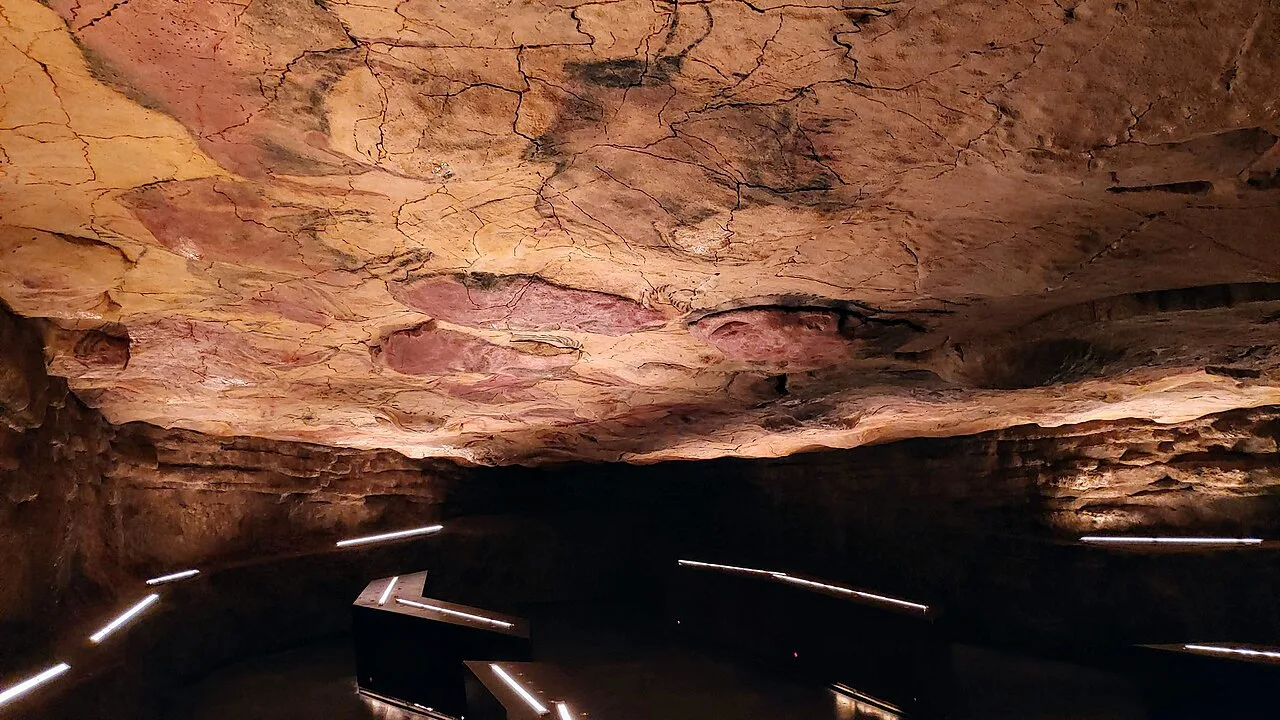
- Cantabrian Cornice (18 caves designated UNESCO World Heritage, 1985 and 2008): In Cantabria shines Altamira Cave, whose Polychrome Ceiling was discovered by the young girl María Sanz de Sautuola in 1879. It achieved worldwide recognition following Émile Cartailhac's celebrated Mea culpa d'un sceptique in 1902. Accompanying it are the Monte Castillo complex (El Castillo, La Pasiega, Las Monedas, and Las Chimeneas), Covalanas, El Pendo, the pristine cave floors of La Garma, Chufín, Hornos de la Peña, and El Mirón. In Asturias, notable sites include Tito Bustillo, Peña de Candamo, El Pindal, Llonín, La Covaciella, El Buxu, and La Loja. In the Basque Country, highlights include Ekain, Altxerri, Santimamiñe, alongside recent discoveries such as Atxurra (2015), Armintxe (2016, featuring cave lions), and Aitzbitarte (2015).
- The Northwest and the Pyrenean axis: Cova Eirós (Lugo, 2011–2012) opened the map of Galician Paleolithic art. Alkerdi I and II connect Navarre with the Pyrenean world, and Fuente del Trucho (Huesca) preserves more than fifty hand stencils south of the Pyrenees.
- The Inland Plateau (the future homeland of the Carpetani and their neighbors): Far from being a frozen wasteland, the Central Plateau (Meseta Central) preserves a rich corridor of engraved sanctuaries in the valleys of the Lozoya, Jarama, Henares, and upper Tagus rivers. Highlights include El Reguerillo Cave (Patones, Madrid), Los Casares, La Hoz, and El Reno (Guadalajara), along with La Griega (Segovia), Penches (Burgos), and El Niño Cave (Albacete). On their walls appear horses, goats, singular human figures, and even mammoths and woolly rhinoceroses.
- Andalusia, the Mediterranean Watershed, and Portugal: In the south, standout sites include La Pileta (>3,000 motifs), Ardales, Ambrosio Cave, El Morrón, and Nerja, where "soot archaeology" (Medina-Alcaide et al., 2023) confirmed torchlit visits starting 41,200 years ago. Along the Mediterranean, Cova Dones (Millares, Valencia; Ruiz-Redondo et al., 2023, Antiquity) stands out with more than a hundred figures painted in red clay. These are joined by Arco Cave (Murcia) and the engravings on silt in Cova de la Font Major (Tarragona, 2019). In Portugal shines Gruta do Escoural (Alentejo), and spanning Portugal and Salamanca rise the great open-air rock art complexes of the Côa Valley and Siega Verde (UNESCO, 1998/2010).
3.4 The Underground Workshop, Non-Invasive Science, and the Conservation Challenge
To paint in the absolute blackness of the cave, artists ground iron oxides (hematite, goethite, limonite) to obtain reds, ochres, and yellows, and used charcoal or manganese dioxide for black pigments. Mineral-rich cave water, saturated with calcium carbonate, almost always served as a sufficient natural binder.
They applied color with their fingers, plant-fiber brushes, pads (dabbed technique / tamponado), or by blowing pigment (aerography). They combined this with fine incising and striated engraving executed with flint burins, using every natural bulge in the rock face as if it were the contoured muscle of a bison. They illuminated their workspace with resinous wooden torches and stone lamps fueled by animal fat and plant wicks, whose flickering flames brought the figures to life.
Today, this heritage is investigated without ever touching the walls through AMS Radiocarbon dating, Uranium-Thorium dating, soot archaeology, 3D photogrammetry, DStretch digital image enhancement, and portable Raman spectroscopy. To halt microclimatic deterioration and the "green sickness" (mal verde) caused by 20th-century mass tourism, Spain and Portugal spearhead an exemplary model. It combines the preventive closure of the most fragile caves with exact scientific replicas such as the Neocave of Altamira, Ekainberri, and the Prehistory Park of Teverga.
Delve Deeper into Age III and Explore the 57 Iberian Caves
Read the complete monograph Age III: The Golden Age of Caves. You can also consult the full atlas Caves with Rock Art in the Iberian Peninsula and the 57 illustrated site sheets with 233 photographs in the Master Cave Index.
Sources and References for Age III
- Cartailhac, É. (1902), «Les cavernes ornées de dessins. La grotte d'Altamira, Espagne. "Mea culpa" d'un sceptique», L'Anthropologie, 13, pp. 348–354.
- González Sainz, C., Cacho Toca, R. and Fukazawa, T. (2003), Arte Paleolítico en la Región Cantábrica, Santander, Universidad de Cantabria.
- Lasheras, J. A. (ed.) (2003), Redescubrir Altamira, Madrid, Turner / Museo de Altamira.
- Medina-Alcaide, M.ª Á., Vandevelde, S., Garate, D. et al. (2023), «35,000 years of recurrent visits inside Nerja cave (Andalusia, Spain) based on charcoals and soot micro-layers analyses», Scientific Reports, 13, 5901.
- Pike, A. W. G., Hoffmann, D. L., Zilhão, J. et al. (2012), «U-Series Dating of Paleolithic Art in 11 Caves in Spain», Science, 336 (6087), pp. 1409–1413.
- Ruiz-Redondo, A., Barciela, V. and Martorell, X. (2023), «Cova Dones: a major Palaeolithic cave art site in eastern Iberia», Antiquity, 97 (396), e32.
- Sanchidrián Torti, J. L. (2001), Manual de arte prehistórico, Barcelona, Ariel.
- Sanz de Sautuola, M. (1880), Breves apuntes sobre algunos objetos prehistóricos de la provincia de Santander, Santander.
- Straus, L. G., González Morales, M. R., Carretero, J. M. and Marín-Arroyo, A. B. (2015), «"The Red Lady of El Mirón"», Journal of Archaeological Science, 60, pp. 134–137.
- Villalba-Mouco, V. et al. (2023), «A 23,000-year-old southern Iberian individual links human groups that lived in Western Europe before and after the Last Glacial Maximum», Nature Ecology & Evolution, 7, pp. 597–609.
Age IV · From the End of the Ice to the First Metals: Mesolithic, Neolithic, Chalcolithic, and the Bronze Age (ca. 10,500 – 800 BCE)
Around 11,700 years ago (circa 9700 BCE), temperatures rose rapidly and the Holocene began—the warm epoch in which we still live today. The ice sheets retreated, sea levels rose to carve out our modern coastlines, glacial megafauna vanished from Iberia, and the old cold steppes transformed into forests of holm oaks, deciduous oaks, pines, and cork oaks. In less than nine millennia, the inhabitants of the Peninsula went from small bands of shellfish gatherers to raising megalithic monuments, smelting copper and bronze, constructing state-like fortresses, and forging the demographic foundation of the Central Plateau (Meseta Central).
4.1 Mesolithic and Epipaleolithic: Hunters of the Forest and the Sea (ca. 10,500 – 5,600 BCE)
Adapted to the new forests and coasts, the last hunter-gatherers developed an economy closely linked to the littoral and rivers. Along the Cantabrian coast (Asturian culture) and in the Tagus estuary in Portugal (the immense Muge shell middens), they accumulated entire hills of limpet, cockle, and mussel shells alongside human burials. In lithic production, microliths stood out—tiny geometric flint pieces mounted in series on wooden handles or shafts to create arrows and harpoons. In the far south, overlooking the ancient La Janda lagoon (Cádiz), the rock shelter of Tajo de las Figuras vividly portrayed that world of wetlands and aquatic birds (Arte Sureño / Southern Rock Art).
4.2 The Neolithic Revolution, Ancient DNA, and Megalithism (ca. 5,600 – 3,200 BCE)
Around 5600–5500 BCE, the greatest economic and social shift of Prehistory reached the Iberian Mediterranean shores: the Neolithic. Paleogenomics (Olalde et al., 2019, Science) has confirmed that ideas did not arrive alone, but rather with small groups of seafaring farmers with roots in Anatolia who gradually intermingled with local hunter-gatherers. They brought wheat, barley, legumes, sheep, goats, pigs, cattle, polished stone axes, and the earliest pottery—known as cardial pottery because it was decorated by impressing the serrated edges of cockle shells (Cerastoderma edule).
Sites such as Cova de l'Or (Alicante), Cueva de la Carigüela (Granada), and Cueva de los Murciélagos (Zuheros, Córdoba) attest to the rapid agricultural expansion along the Ebro, Guadalquivir, Tagus, and Duero river basins. To these are added the famous esparto grass sandals and basketry over 6,000 years old preserved in the Cueva de los Murciélagos of Albuñol (Granada).
As they put down roots in the land, communities erected monumental collective stone tombs known as dolmens (Megalithism). Outstanding among them is the Antequera Dolmens Site (Málaga—Menga, Viera, and the El Romeral tholos, UNESCO World Heritage 2016), oriented toward prominent rock formations and celestial bodies. Other notable examples include the Dolmen de Soto (Huelva), the Almendres Cromlech (Cromeleque dos Almendres) in the Portuguese Alentejo, and hundreds of monuments stretching from Galicia and the Basque Country to the Meseta.
4.3 Holocene Art: From Sunlit Rock Shelters to Sealed Sanctuaries
The new farming and metallurgical societies developed three major artistic traditions studied in our Cave Atlas:
- Macroschematic Art (Alicante mountains, Early Neolithic): large orant human figures and meandering serpentiform lines.
- Levantine Art (UNESCO World Heritage 1998, over 750 rock shelters across the Mediterranean Basin): leaves the subterranean gloom behind in favor of sunlit open-air shelters. It places the human figure at center stage in vibrant scenes of hunting, dancing, and honey gathering, as at La Araña (Bicorp), Roca dels Moros (El Cogul), and Cueva del Niño (Albacete).
- Schematic Art (Neolithic to Bronze Age): reduces humans, animals, and celestial bodies to highly expressive abstract signs, such as the famous Indalo of Cueva de los Letreros (Almería) or the oculated idols of La Serreta (Murcia). Furthermore, it left behind exceptional sealed subterranean sanctuaries with intact offerings, such as Galería del Sílex in Atapuerca, Ojo Guareña (Burgos), Cova de la Vila (Tarragona), and Algar da Água (Portugal).
4.4 The Copper Age (Chalcolithic) and the Ciempozuelos Bell Beaker Style (ca. 3,200 – 2,200 BCE)
With the advent of copper metallurgy and the ox-drawn plow, population, long-distance trade, and social inequalities surged. In the south and west, fortified settlements emerged with concentric walls and bastions, such as Los Millares (Almería) and Zambujal (Portugal). Grand ritual centers also flourished, such as Valencina de la Concepción (Seville), whose Montelirio tholos tomb held hundreds of thousands of shell beads, African ivory, amber, and rock crystal.
Around 2600–2500 BCE, the prestige package of the Bell Beaker culture (Vaso Campaniforme) swept across Western Europe: inverted bell-shaped vessels, copper daggers, metal projectile points, and archer's wristguards (bracers). In Iberia, the genomic study by Olalde et al. (2019, Science) revealed an astonishing shift between 2500 and 2000 BCE: the arrival of groups with Steppe-related ancestry replaced roughly 40% of the overall ancestry and nearly 100% of previous male lineages (Y chromosome). One of the finest Bell Beaker styles in Europe emerged precisely within the future territory of Carpetania: the Ciempozuelos style (Madrid), characterized by polished black pottery decorated with incisions inlaid with white paste.
4.5 The Bronze Age and the Cogotas I Horizon: The Roots of the Meseta (ca. 2,200 – 800 BCE)
By alloying copper and tin, bronze emerged, shaping four major cultural spheres across Iberia:
- The El Argar culture (Southeast, ca. 2200–1550 BCE): Notable for fortified settlements on steep hilltops (La Bastida, La Almoloya, Peñalosa) and intramural burials beneath house floors. It sustained a highly hierarchical, state-level society wielding silver diadems, halberds, and swords (Lull et al.).
- The Motillas of La Mancha (ca. 2200–1500 BCE): Circular fortresses with concentric walls erected around deep wells to secure water during prolonged droughts, exemplified by the Motilla del Azuer (Daimiel).
- The Atlantic Bronze Age and the Talayotic World: Atlantic maritime networks trading tin, bronze, and gold from Portugal and Galicia to the British Isles; cyclopean stone towers (talayots) in the Balearic Islands.
- The Cogotas I Horizon (ca. 1700/1500 – 900/800 BCE): Across both sub-plateaus—with exceptional density along the Manzanares, Jarama, Henares, and Middle Tagus river valleys—flourished the earliest foundation of the Carpetani. Their communities inhabited pit-field villages (campos de hoyos, such as Perales del Río, Getafe) and elevated hilltops (Cerro del Ecce Homo), practicing periodic mobility tied to pastoralism and seasonal farming. Their hallmark is handmade black burnished pottery decorated with incision, excision, and boquique ("stab-and-drag" / "punto en raya") technique inlaid with white paste (Abarquero Moras, 2005; Blasco Bosqued, 1997). While some researchers link this culture to a "Proto-Celtic" phase, others urge caution given the total absence of written records.
Delve deeper into Age IV (including the complete Cogotas I section from Los Carpetanos)
Read the full monograph Age IV: Mesolithic, Neolithic, Chalcolithic, and Bronze Age, and also consult Caves with Rock Art and chapter2.1of The Carpetani — Expanded Edition.
Sources and References for Age IV
- Abarquero Moras, F. J. (2005), Cogotas I. La difusión de un tipo cerámico durante la Edad del Bronce, Valladolid, Junta de Castilla y León.
- Barandiarán, I., Martí, B., Rincón, M.ª A. del, and Maya, J. L. (2012), Prehistoria de la Península Ibérica, Barcelona, Ariel.
- Blasco Bosqued, M.ª C. (1997), "La Edad del Hierro en la Región de Madrid," Boletín de la Asociación Española de Amigos de la Arqueología, 37 (and studies on Cogotas I and Ciempozuelos Bell Beaker).
- García Sanjuán, L. et al. (2016–2023), studies on the Antequera Dolmens, Valencina de la Concepción, and the Montelirio tholos, Universidad de Sevilla.
- Lull, V., Micó, R., Rihuete Herrada, C., and Risch, R. (2011–2021), research on El Argar (La Bastida, La Almoloya), Universitat Autònoma de Barcelona / Antiquity.
- Nájera Colino, T. and Molina González, F. (studies on the Motilla del Azuer and the Bronze Age of La Mancha, Universidad de Granada).
- Olalde, I., Lalueza-Fox, C., Reich, D. et al. (2019), "The genomic history of the Iberian Peninsula over the past 8000 years," Science, 363 (6432), pp. 1230–1234.
Age V · The Iron Age: Mediterranean Colonizations, Pre-Roman Peoples, and the Carpetani (9th–3rd Centuries BCE)
With the first millennium BCE, the Iberian Peninsula crossed the threshold of Protohistory. Although almost none of its peoples left chronicles of their own, their names, cities, and customs already appear in the accounts of Greek and Roman navigators and geographers. Two major catalysts transformed the territory: Mediterranean commercial colonizations and the everyday spread of iron.
5.1 Phoenicians, Tartessos, and Greeks: The Mediterranean Awakening (9th–6th Centuries BCE)
Attracted by the silver, copper, tin, and gold of Iberia, Phoenician navigators from Tyre (modern-day Lebanon) founded a network of colonies along the south and the eastern coast (Levante) beginning in the 9th–8th centuries BCE (Aubet, 2009). Notable among them were Gadir (Cádiz, the oldest city in the West), Malaka (Málaga), Sexi (Almuñécar), Abdera (Adra), Toscanos, and Castillo de Doña Blanca, and their ships reached the Tagus estuary. They introduced iron, the fast potter's wheel, high-temperature kilns, alphabetic writing, and grid-plan urbanism. They also introduced the domestic chicken and the commercial cultivation of grapevines and olive trees.
From the encounter between southwestern communities and Phoenician trade arose Tartessos (8th–6th centuries BCE), celebrated by the Greeks through figures such as King Arganthonios in Herodotus (Celestino Pérez, 2016). Alongside the classic treasures of the lower Guadalquivir and Huelva (El Carambolo), astonishing discoveries are being made today in the Extremaduran valley of the Guadiana River. Outstanding examples include the sanctuary of Cancho Roano and the monumental complex of Casas del Turuñuelo (Guareña, Badajoz), famous for its massive animal sacrifice and the first known sculpted Tartessian faces. Their trade routes traveled up the Guadiana and the Tagus, ultimately transforming the center of the Meseta.
Beginning in the 6th century BCE, Phocaean Greek sailors founded Emporion (Ampurias) and Rhode (Roses) on the Catalan coast. They stimulated the influx of coinage, olive oil, wine, and luxury tableware (Attic black-gloss pottery), while the Punic (Carthaginian) sphere consolidated its base in Ebusus (Ibiza).
5.2 The Mosaic of Pre-Roman Peoples of the Iberian Peninsula
Between the 6th and 3rd centuries BCE, the combination of local Late Bronze Age roots, northern Celtic influences, and Mediterranean currents shaped a vibrant mosaic of peoples (Salinas de Frías, 2007; Almagro-Gorbea, 2014):
| Major cultural sphere | Primary peoples | Territory | Distinctive traits |
|---|---|---|---|
| Iberian Area (non-Indo-European language) | Turdetani, Oretani, Bastetani, Contestani, Edetani, Ilergetes, Laietani | Andalusia, Murcia, Valencian Community, Catalonia, and the lower Ebro | Walled cities, Iberian script and early coinage, wheel-thrown painted pottery, stone sculpture (Lady of Elche, Lady of Baza) |
| Celtiberian Area (Hispano-Celtic) | Arevaci, Belli, Titti, Lusones, Pelendones | Iberian System, upper Duero, upper Tagus, and middle Ebro Valley | Celtic language written in Iberian semi-syllabary (Botorrita Bronzes), large oppida (Numantia, Termes, Segeda), warrior aristocracy |
| Indo-European Area of the Meseta and the West | Carpetani, Vaccaei, Vettones, Lusitanians | Central Plateau (Meseta Central), middle Duero, Extremadura, and Portugal | Cereal farmers (Vaccaei and Carpetani) or pastoralists (Vettones, creators of the granite verracos); family clans (gentilitates); no single monarch |
| Northern and Pyrenean Area | Gallaeci, Astures, Cantabri, Autrigones, Vascones | Galicia, Cantabrian Cornice, northern Portugal, and western Pyrenees | Hillfort culture of fortified castros with circular houses in the northwest, gold metalwork (torcs), Proto-Basque language among the Vascones |
5.3 The Carpetani: The "Bridge People" of the Middle Tagus Valley
In the heart of the Peninsula dwelt the Carpetani (Karpetanoi in Greek, Carpetani in Latin, and Karpesioi in Polybius). Their territory followed the middle course of the Tagus River and its tributaries: Jarama, Henares, Tajuña, Manzanares, Guadarrama, Alberche, Algodor, Cigüela, and Záncara. It spanned nearly the entire Community of Madrid, a large part of Toledo, western and southern Guadalajara, the western edge of Cuenca, and northern Ciudad Real, maintaining open and dynamic frontiers against the Vaccaei, Arevaci, Celtiberians, Oretani, and Vettones.
Linguists link their name to the pre-Roman root *karpa- ("rock," "crag," or "escarpment"): they were the inhabitants of "the country of the escarpments" (Urbina Martínez, 1998), a landscape of gypsum cliffs, elevated plateaus (páramos), and fertile floodplains. Their central position turned them into a true "bridge people" (Ruiz Zapatero, 2012, 2014) between the Hispano-Celtic world of the interior and the Mediterranean Iberian sphere.
- Four stages of formation (ethnogenesis): Built upon the foundation of Cogotas I (examined in Age IV), there followed a decisive phase overlooked by older syntheses: the First Iron Age (8th–5th centuries BCE). At Cerro del Ecce Homo, Arroyo Culebro, Las Camas, and the necropolis of Las Madrigueras, Meseta traditions coexisted with the earliest iron objects and Phoenician-Tartessian goods (Blasco Bosqued, 1997; Torres Rodríguez, 2013). Next, Celtiberian influence (6th–4th centuries BCE) popularized everyday iron use, hilltop fortified settlements (castros), rectangular houses, and clan organization (gentilitates). Finally, Iberianization (5th–3rd centuries BCE) introduced the fast potter's wheel, double-chamber kilns, the rotary quern, painted and marbled pottery, the falcata sword, and Greek Attic pottery.
- Cities, oppida, and daily life: Alongside lowland villages such as Miralrío (Rivas-Vaciamadrid) and Arroyo Culebro, large, fortified hilltop oppida arose. Prominent among them were Toletum (Toledo, Carpetaniae caput in Pliny), Complutum (on the Cerro de San Juan del Viso), and El Llano de la Horca (Santorcaz, approximately 14 ha with paved streets up to 5 meters wide rutted by cart traffic). Also noteworthy are Titulcia, Caraca (Driebes, Guadalajara), Consabura (Consuegra), Dehesa de la Oliva (Patones), Cerro de la Gavia (Vallecas), and Plaza de Moros (Villatobas). Along the eastern border zone, Contrebia Carbica (Fosos de Bayona, 33–45 ha) and Segobriga stand out. Their typical houses (50–100 m², stone socles, and whitewashed adobe walls) featured a well-lit entrance vestibule, a main room with a central hearth, and a rear storeroom.
- A balanced society and the salt economy: Lacking a single king or monumental princely tombs, they formed a flexible network of independent communities structured around clans (gentilitates ending in -kum or -qum), led by equestrian elites and temporary chieftains (reguli). Their dryland cereal farming (barley, wheat, legumes, and acorn flour) and sheep and cattle husbandry were complemented by the "white gold" of the inland salt works. They exploited the Espartinas Salt Works (Ciempozuelos), Belinchón, Imón, and the La Mancha salt lagoons (Valiente Cánovas et al., 2014). Prior to the late indigenous coinages (Konterbia Karbika, Ikesankom Konbouto, TOLE), long-distance trade weighed out chopped scrap silver (hacksilber).
- Language, beliefs, and the funerary world: They spoke a Hispano-Celtic language closely related to Celtiberian. Although long believed to have been illiterate, we now know of graffiti scratched on pottery, hospitality tokens (tesserae hospitales), and coin legends from the 2nd–1st centuries BCE (Gamo Pazos, 2014). They venerated nature and deities such as Togo, Airón, Epona, the Matres, and the Nymphs. It is worth noting that Ataecina and Bandua belong to the Lusitanian-Vettonian sphere and that no classical source attributes the ritual excarnation of fallen warriors by vultures to the Carpetani. In necropolises such as Palomar de Pintado and Las Esperillas, they cremated their deceased in cinerary urns beneath adobe tumuli, though the scarcity of late cemeteries in Madrid remains an open archaeological mystery.
- Four Carpetanian masterpieces: Outstanding among them is the Patera of Titulcia (near-pure silver ~98–98.7% with gold gilding, 4th–3rd centuries BCE, MARPA). It is accompanied by the Terracotta Relief of El Cerrón de Illescas (fired clay, not stone, 4th century BCE, Santa Cruz Museum). Completing the group are the Bronze Plaque of Santorcaz (MARPA) and the Treasure of Driebes (~14 kg of silver in hacksilber, MAN).
Read all of Age V with the complete text of The Carpetani (Chs. 1.0 to 5.0)
The monograph Age V: The Iron Age and the World of the Carpetani provides the full framework of Phoenicians, Tartessos, Greeks, and pre-Roman peoples. It also integrates the complete text of the Clarifications Table, Ptolemy's 18 cities, and chapters1.0to5.0of The Carpetani — Expanded Edition.
Sources and References for Age V
- Classical sources: Herodotus, Histories, I, 163; Strabo, Geography, III, 1–4; Pliny the Elder, Naturalis Historia, III, 19 and 25; Claudius Ptolemy, Geographia, II, 6, 56; Polybius, Histories, III, 14, 2; Silius Italicus, Punica, III, 340–343; Claudius Aelianus, De Natura Animalium, X, 22.
- Scientific bibliography: Almagro-Gorbea, M. (ed.) (2014), Protohistoria de la Península Ibérica, Burgos; Álvarez-Sanchís, J. R. (1999), Los Vettones, Madrid, RAH; Aubet, M.ª E. (2009), Tiro y las colonias fenicias de Occidente, Barcelona, Bellaterra; Balmaseda Muncharaz, L. J. and Valiente Cánovas, S. (1981), "El relieve de Illescas," AEspA, 54; Baquedano Pérez, E. (ed.) (2014), I Simposio sobre los Carpetanos, Zona Arqueológica, 17; Celestino Pérez, S. (2016), Tartessos, Madrid; Ruiz Zapatero, G. et al. (2012), Los últimos carpetanos, MARPA; Salinas de Frías, M. (2007), Los pueblos prerromanos de la Península Ibérica, Madrid, Akal; Torres Rodríguez, J. de (2013), La Tierra sin Límites, Zona Arqueológica, 16; Urbina Martínez, D. (1998, 2000), studies on Carpetania and the Mesa de Ocaña.
Age VI · Carthage, Rome, and the End of Carpetanian Culture (237 BCE – 1st Century BCE)
The final act of our chronicle moves at a breakneck pace. In barely two centuries, the clash between Carthage and Rome for control of the Mediterranean transformed the entire Iberian Peninsula. Located at the crossroads of the peninsula, Carpetania went from resisting invaders to becoming Rome's loyal rearguard. It endured first the Lusitanian raids and later the Roman civil wars, until its ancient pre-Roman structures dissolved in the 1st century BCE.
6.1 The Barcid Empire, the Battle of the Tagus, and the Second Punic War (237 – 206 BCE)
After losing Sicily in the First Punic War, the Carthaginian Barcid family sought silver and soldiers in Iberia. In 237 BCE, Hamilcar Barca landed in Gadir. His son-in-law Hasdrubal founded Qart Hadasht (Cartagena, 227 BCE) and signed the Ebro Treaty with Rome (226 BCE). Upon taking command in 221 BCE, the young Hannibal Barca subdued the Olcades, and in 220 BCE he sacked the Vaccaean cities of Helmantike and Arbucala.
On his return south, the great Battle of the Tagus (220 BCE) broke out. The Carpetani—whom Polybius (The Histories, III, 14, 2) called "perhaps the most powerful people of those parts"—allied with the Olcades and Vaccaei. They barred his passage with a massive army, exaggerated by Polybius and Livy to 100,000 men and estimated today at 30,000–40,000 combatants. Hannibal crossed the ford by night, threw up a palisade, and crushed the native forces in the river with his cavalry and forty war elephants.
Even after their defeat, the Carpetani rose up again alongside the Oretani during the siege of Saguntum (219 BCE) (Livy, XXI, 11, 13). In 218 BCE, they were also the protagonists of the famous en masse desertion of 3,000 Carpetanian infantrymen at the foot of the Pyrenees upon learning they were marching to Italy (Livy, XXI, 23, 4–6). The terror of those years remained etched underground in the conflagration of Plaza de Moros and the burial of the Driebes Hoard.
That same year, 218 BCE, the legions of Gnaeus Cornelius Scipio landed at Emporion (Empúries). Twelve years of war culminated in the daring capture of Qart Hadasht by Scipio Africanus (209 BCE), his victories at Baecula (208 BCE) and Ilipa (206 BCE), and the fall of Gadir. Carthage was expelled from Iberia, and in 197 BCE Rome created two permanent provinces: Hispania Citerior and Hispania Ulterior.
6.2 The Roman Conquest of the Meseta and the Treaties of Gracchus (193 – 179 BCE)
After crushing the initial coastal revolts (Cato's campaign in 195 BCE), the legions advanced toward the Tagus and unleashed fourteen years of fighting recorded by Livy:
- 193–192 BCE: Praetor Marcus Fulvius Nobilior defeated a Meseta coalition near Toletum and captured the Carpetanian chieftain (regulus) Hilernus alive (Livy, XXXV, 7, 8). The following year, he took Toletum ("a small town, but fortified by its location", XXXV, 22, 8) with siege engines after repulsing a Vettonian relief army.
- 185–181 BCE: Carpetani, Vettones, and Celtiberians initially defeated Piso and Crispinus near Hippo, but were beaten shortly after on the banks of the Tagus (185 BCE; Livy, XXXIX, 30–31). In 181 BCE, Quintus Fulvius Flaccus triumphed at the Carpetanian city of Aebura and captured the major border fortress of Contrebia Carbica (Fosos de Bayona; Livy, XL, 30–33).
- 180–179 BCE: Tiberius Sempronius Gracchus captured Certima, Alce—where the powerful Celtiberian chieftain Thurro surrendered—and Ercavica (Livy, XL, 47–50). His treaties (foedera and amicitia) inaugurated a period of stability: in exchange for loyalty, a fixed tribute (stipendium), auxiliary troops, and a ban on building new fortifications, the Carpetanian cities retained their local autonomy.
6.3 Lusitanian, Celtiberian, and Sertorian Wars: A Century of Fire (155 – 72 BCE)
While Celtiberia endured the war that culminated in the destruction of Numantia (133 BCE) by Scipio Aemilianus, the Lusitanian chieftain Viriathus (147–139 BCE) repeatedly raided the fields of Carpetania, which was already serving as Rome's loyal rearguard. Around 146 BCE, he defeated praetor Gaius Plautius near mons Veneris (Appian, Iberike, 64–65; Frontinus, Strat. III, 10–11). No Carpetanian city defected to Viriathus, but that crisis coincided with the burning of the sanctuary of Titulcia and the concealment of its silver patera.
The definitive blow to the pre-Roman order came with the Sertorian Wars (82–72 BCE), when the rebel general Quintus Sertorius fought in Hispania against the senatorial armies of Metellus and Pompey. Loyal to the Senate, the Carpetanian cities paid a heavy price between 78 and 76 BCE. Notable events include the heroic resistance of Consabura (Consuegra) against Hirtuleius (Frontinus, IV, 5, 19) and the 44-day siege and fall of Contrebia Carbica (Livy, fr. XCI). To these can be added the stratagem of white dust used against the Characitani in the Tajuña caves (Plutarch, Sertorius, 17) and the siege traces from 77 BCE unearthed at Caraca (Driebes; Fernández Ortea and Gamo Pazos, 2020).
6.4 The 1st Century BCE: Abandonment of the Oppida and the Birth of Roman Hispania
Following the assassination of Sertorius (72 BCE), the civil wars between Caesar and Pompey shook Hispania once more (Ilerda, Munda). Shortly thereafter, Augustus brought the conquest of the peninsula to a close with the Cantabrian Wars (29–19 BCE). Within this framework of the 1st century BCE, the ancient pre-Roman Carpetanian culture came to an end:
- Abandonment of hilltop oppida: Traditional settlements such as El Llano de la Horca, Cerro de la Gavia, and Fosos de Bayona were destroyed or abandoned during the 1st century BCE. Life shifted to Romanized cities in the lowlands and along the new roads. Thus, Complutum relocated from Cerro de San Juan del Viso down to the Henares valley. Meanwhile, Toletum, Consabura, Caraca, and Segobriga—spurred by its lapis specularis mines—erected forums, thermal baths, and aqueducts.
- Latin, coinage, and provincial integration: Toletum was already minting bronze coins in the Latin alphabet (
TOLE) in the first half of the 1st century BCE. Campanian pottery and Italian amphorae filled pantries, and the Hispano-Celtic language gave way to Latin. Under the provincial reorganization of Augustus, ancient Carpetania was integrated into Hispania Citerior Tarraconensis (divided between the conventus Carthaginensis and the conventus Caesaraugustanus). Decades later, Vespasian granted Latin rights (ius Latii, 73–74 CE). Thus ended a cycle of nearly one and a half million years in pre-Roman Iberia.
Read the complete Age VI with the unabridged text of The Carpetani (Chs. 6.0 to 9.0)
The monograph Age VI: Carthage, Rome, and the End of Carpetanian Culture brings together the full peninsular framework of the conquest and Romanization. It also integrates the unabridged text of chapters6.0(conflicts),7.0(sites and museums),8.0(chronology), and9.0(complete and detailed sources and bibliography) from The Carpetani — Expanded Edition.
Sources and References for Age VI
- Classical sources: Polybius, The Histories, III, 13–14; Livy, Ab Urbe Condita, XXI, 5, 11, 23; XXXV, 7, 22; XXXIX, 30–31; XL, 30–33, 47–50; fr. XCI; Appian, Iberike, 56–75; Plutarch, Sertorius, 17; Frontinus, Strategemata, III, 10–11 and IV, 5, 19; Strabo, Geography, III; Pliny the Elder, Naturalis Historia, III, 19 and 25; Antonine Itinerary, 436–438.
- Scientific bibliography: Azcárraga Cámara, S. (2014), «Nuevos datos sobre la romanización de la Carpetania centro-septentrional», Zona Arqueológica, 17; Bendala Galán, M. (2015), Hijos del rayo. Los Barca y el dominio cartaginés en Hispania, Madrid; Fernández Ortea, J. and Gamo Pazos, E. (2020), Caraca. La ciudad romana en el Cerro de la Virgen de la Muela, Guadalajara; Gamo Pazos, E. (2018), La romanización de celtíberos y carpetanos en la Meseta oriental, Zona Arqueológica, 22; Quesada Sanz, F. (2008), Armas de Grecia y Roma; Roldán Hervás, J. M. and Wulff Alonso, F. (2001), Citerior y Ulterior. Las provincias romanas de Hispania en la era republicana, Madrid, Istmo.
7.0 Grand Master Chronological Table of the Iberian Peninsula (1.4 Ma – 1st Century BCE)
| Age | Approximate dates | Key events, cultures, and species | Monograph and key links on carpetanos.net |
|---|---|---|---|
| Age I · Early Pleistocene | 1.4 – 0.8 Ma | First hominins of western Europe: Orce human molar (~1.4 Ma), "Pink" facial bone (Homo aff. erectus, 1.1–1.4 Ma, Nature 2025), TE9 mandible (~1.2 Ma), and Homo antecessor (~850 ka). Mode 1 technology (Oldowan). |
Age I Monograph · Barranco León, Fuente Nueva 3, Sima del Elefante, and Gran Dolina. |
| Age I · Middle Pleistocene | 780,000 – 130,000 years ago | Acheulean culture (handaxes, Mode 2), mastery of fire (Bolomor), and direct ancestors of the Neanderthals (Sima de los Huesos, ~430 ka, nuclear DNA, "Miguelón" and "Excalibur"). Manzanares and Jarama river terraces. | Age I Monograph · El Castillo · Font Major. |
| Age II · Middle Paleolithic | 130,000 – 40,000 years ago | Homo neanderthalensis and Mousterian culture (Levallois technique). El Sidrón, skull sanctuary of Pinilla del Valle (2023). Debate over subterranean symbolism (>65,000 years ago U-Th) and the Gibraltar engraving (>39,000 years ago). | Age II Monograph · La Pasiega, Maltravieso, Ardales, Gorham · Cave Atlas. |
| Age III · Upper Paleolithic | 41,000 – 10,500 years ago | Homo sapiens: Aurignacian, Gravettian, Solutrean, and Magdalenian. World peak of rock art in caves and open air (polychromy, stamp-dabbing, blowing/stencil aerography, striated engraving, Red Lady of El Mirón). | Age III Monograph · Altamira, Covalanas, Ekain, El Reguerillo, Cova Dones · Index of 57 Caves. |
| Age IV · Mesolithic and Neolithic | 10,500 – 3,200 BCE | Holocene thaw, shell middens (Muge, Asturian). Agricultural revolution and Cardial pottery (~5600 BCE). Megalithism (Antequera, Almendres). Levantine and Macroschematic Art. | Age IV Monograph · Tajo de las Figuras, Cueva de la Araña, Roca dels Moros. |
| Age IV · Chalcolithic and Bronze Age | 3,200 – 800 BCE | Copper and bronze: Los Millares, Valencina, Bell Beaker (Ciempozuelos), and steppe genetic turnover (Olalde et al.). Subterranean schematic sanctuaries. El Argar, Motillas, Atlantic Bronze, and Cogotas I Horizon (1700–800 BCE). | Age IV Monograph · Galería del Sílex, Cova de la Vila · The Carpetani. |
| Age V · Iron Age | 9th – 3rd Centuries BCE | Phoenician colonies (Gadir), Tartessos (Cancho Roano, Casas del Turuñuelo), and Greek colonies (Emporion). Pre-Roman peoples (Iberians, Celtiberians, Vettones, Vaccaei, Lusitanians, Northern peoples). Rise of The Carpetani: oppida, saltworks, Titulcia Patera, and Illescas Relief. | Age V Monograph · The Carpetani (Chs. 1.0–5.0 unabridged in Age V). |
| Age VI · Carthage and Rome | 237 BCE – 1st Century BCE | Battle of the Tagus against Hannibal (220 BCE), Second Punic War, Roman conquest of Carpetania (193–179 BCE), Lusitanian Wars, Numantia (133 BCE), Sertorian Wars (82–72 BCE), abandonment of the oppida, and full Romanization under Augustus. | Age VI Monograph · The Carpetani (Chs. 6.0–9.0 unabridged in Age VI). |
8.0 Navigation Map, Library, and Museums of carpetanos.net
This Main Guide articulates the entire documentary architecture of carpetanos.net across three complementary tiers:
- Chronological collection of the Six Ages (
1.4 Ma – 1st Century BCE): - Specialized thematic volumes:
- Editorial standard: Verbal Identity Guide of
carpetanos.net.
Six Essential Museums to Experience this Journey in Person
| Museum | Location | Eras and featured treasures |
|---|---|---|
| Museum of Human Evolution (MEH) | Burgos | Age I: Original fossils from the Sierra de Atapuerca (Sima del Elefante, Gran Dolina, and Sima de los Huesos: "Miguelón", "Elvis", "Excalibur"). |
| "Josep Gibert" Museum of the First Inhabitants of Europe | Orce (Granada) | Age I: Early Pleistocene fauna and Oldowan material culture from Barranco León and Fuente Nueva 3. |
| National Museum and Research Center of Altamira | Santillana del Mar (Cantabria) | Ages II–III: The Neocave of Altamira, Cantabrian portable art, mineral pigments, Paleolithic lighting, and preventive conservation. |
| National Archaeological Museum (MAN) | Madrid | Ages I–VI: Comprehensive journey across Iberia: Paleolithic, El Argar, Lady of Elche, Lady of Baza, Driebes Hoard, and pre-Roman and Roman coinage. |
| Archaeological and Paleontological Museum of the Community of Madrid (MARPA) | Alcalá de Henares (Madrid) | Ages I–II and V–VI: Neanderthal sanctuary of Pinilla del Valle and the great Carpetanian treasure: Titulcia Patera, Vessel of the Horses, Santorcaz Plaque, and El Llano de la Horca. |
| Museum of Santa Cruz | Toledo | Ages V–VI: Terracotta relief from El Cerrón de Illescas, falcatas, and grave goods from Palomar de Pintado, Las Esperillas, and Toletum. |
9.0 General Scientific Bibliography and Reference Bodies
(Specific references for each period appear at the close of Ages I through VI. They are also detailed in full in the six monographs of Index of the Six Ages, in Chapter 6.0 of Atlas of the 57 Rock Art Caves, and in Chapter 9.0 of The Carpetani: A Journey to the Origins of the Central Plateau).
A. General Synthesis Works on Iberian Prehistory and Protohistory
- Almagro-Gorbea, M. (ed.) (2014): Protohistoria de la Península Ibérica: del Neolítico a la Romanización, Burgos, Universidad de Burgos / Fundación Atapuerca.
- Barandiarán, I., Martí, B., Rincón, M.ª A. del, and Maya, J. L. (2012): Prehistoria de la Península Ibérica, Barcelona, Ariel.
- Menéndez, M. (coord.) (2012): Prehistoria Antigua de la Península Ibérica and Prehistoria Reciente de la Península Ibérica, Madrid, UNED.
- Roldán Hervás, J. M., and Wulff Alonso, F. (2001): Citerior y Ulterior. Las provincias romanas de Hispania en la era republicana, Madrid, Istmo.
- Salinas de Frías, M. (2007): Los pueblos prerromanos de la Península Ibérica, Madrid, Akal.
B. High-Impact Papers Underpinning This Guide (1997–2025)
- Arsuaga, J. L. et al. (2014): "Neandertal roots: Cranial and chronological evidence from Sima de los Huesos," Science, 344 (6190), pp. 1358–1363.
- Baquedano, E., Arsuaga, J. L., Pérez-González, A. et al. (2023): "A symbolic Neanderthal accumulation of large herbivore crania," Nature Human Behaviour, 7, pp. 342–352.
- Bermúdez de Castro, J. M. et al. (1997): "A Hominid from the Lower Pleistocene of Atapuerca, Spain," Science, 276 (5317), pp. 1392–1395.
- Carbonell, E. et al. (2008): "The first hominin of Europe," Nature, 452 (7186), pp. 465–469.
- Hoffmann, D. L., Zilhão, J., Pike, A. W. G. et al. (2018): "U-Th dating of carbonate crusts reveals Neandertal origin of Iberian cave art," Science, 359 (6378), pp. 912–915.
- Hoffmann, D. L., Angelucci, D. E., Villaverde, V., Zapata, J., and Zilhão, J. (2018): "Symbolic use of marine shells and mineral pigments by Iberian Neandertals 115,000 years ago," Science Advances, 4 (2), eaar5255.
- Huguet, R., Rodríguez-Álvarez, X. P., Martinón-Torres, M. et al. (2025): "The earliest human face of Western Europe," Nature, 640 (8059), pp. 707–713.
- Linscott, B., Devièse, T., Duarte, C., Trinkaus, E., Zilhão, J. et al. (2025): "Direct hydroxyproline radiocarbon dating of the Lapedo child (Abrigo do Lagar Velho, Leiria, Portugal)," Science Advances, 11 (10), eadp5769.
- Medina-Alcaide, M.ª Á. et al. (2023): "35,000 years of recurrent visits inside Nerja cave (Andalusia, Spain) based on charcoals and soot micro-layers analyses," Scientific Reports, 13, 5901.
- Meyer, M., Arsuaga, J. L., Pääbo, S. et al. (2016): "Nuclear DNA sequences from the Middle Pleistocene Sima de los Huesos hominins," Nature, 531 (7595), pp. 504–507.
- Olalde, I., Lalueza-Fox, C., Reich, D. et al. (2019): "The genomic history of the Iberian Peninsula over the past 8000 years," Science, 363 (6432), pp. 1230–1234.
- Pike, A. W. G. et al. (2012): "U-Series Dating of Paleolithic Art in 11 Caves in Spain," Science, 336 (6087), pp. 1409–1413.
- Pitarch Martí, À., Zilhão, J., d'Errico, F. et al. (2021): "The symbolic role of the underground world among Middle Paleolithic Neanderthals," PNAS, 118 (33), e2021495118.
- Rodríguez-Vidal, J., d'Errico, F., Finlayson, C. et al. (2014): "A rock engraving made by Neanderthals in Gibraltar," PNAS, 111 (37), pp. 13301–13306.
- Ruiz-Redondo, A., Barciela, V., and Martorell, X. (2023): "Cova Dones: a major Palaeolithic cave art site in eastern Iberia," Antiquity, 97 (396), e32.
- Toro-Moyano, I., Martínez-Navarro, B., Agustí, J. et al. (2013): "The oldest human fossil in Europe, from Orce (Spain)," Journal of Human Evolution, 65 (1), pp. 1–9.
- Villalba-Mouco, V. et al. (2023): "A 23,000-year-old southern Iberian individual links human groups that lived in Western Europe before and after the Last Glacial Maximum," Nature Ecology & Evolution, 7, pp. 597–609.
- Zilhão, J. et al. (2020): "Last Interglacial Iberian Neandertals as fisher-hunter-gatherers," Science, 367 (6485), eaaz7943.
C. Reference Organizations, Research Centers, and Repositories
- Centro Nacional de Investigación sobre la Evolución Humana (CENIEH) and Fundación Atapuerca (Burgos).
- Institut Català de Paleoecologia Humana i Evolució Social (IPHES) (Tarragona).
- Museo Arqueológico y Paleontológico de la Comunidad de Madrid (MARPA) — editorial collection Zona Arqueológica (nos. 16, 17, and 22).
- Museo Arqueológico Nacional (MAN), Museo de Santa Cruz (Toledo), and Museo Nacional y Centro de Investigación de Altamira.
- UNESCO World Heritage Centre: Inscription files no. 989 (Sierra de Atapuerca), no. 310 (Altamira y arte rupestre del norte de España), and no. 874 (Arco Mediterráneo). They also include files no. 866 (Valle del Côa y Siega Verde), no. 1500 (Cuevas de Gorham), and no. 1501 (Dólmenes de Antequera).