
Table of contents for this page
- 📋 Quick Technical Sheet
- 🗺️ 1. Introduction and Contextualization of the Cave
- 👥 2. The Creators: Characteristics of the Human Population
- 🖌️ 3. Technical Aspects of the Artistic Depictions
- 🔬 4. Archaeological Analysis and Dating Techniques
- 🛡️ 5. Conservation, Current Challenges, and Conclusion
- 🎟️ 6. Visits, Tickets, and Access Permits
- 📚 References and Consulted Documentation
- Official sources for visits, tickets, and permits
Climb a steep slope above the Calera River valley and step into the silence of Mount Pando. There, twenty thousand years ago, strokes made with dots of red earth breathed life and movement into stone.
📋 Quick Technical Sheet
| Feature | Detail |
|---|---|
| Exact location | Northeast slope of Mount Pando, overlooking the Calera River valley, in Ramales de la Victoria (Asón-Agüera region, Cantabria, Spain). |
| Chronology | Upper Paleolithic — Solutrean stage (around 20,000 years ago, within an estimated range between 20,000 and 25,000 years ago). |
| Discovery | 1903, by Hermilio Alcalde del Río and Father Lorenzo Sierra. |
| Primary techniques | Monochrome red painting applied via tamponade or dotting (punteado) with red ochre (lines formed by rows of dots), taking advantage of the natural limestone relief. |
| Iconic figures | Around twenty red hinds—among them the famous hind turning its head backward—, a horse, an aurochs (extinct wild ox), and signs composed of lines and rectangles. |
| Heritage status and access | Asset of Cultural Interest (BIC) and UNESCO World Heritage site (2008). Original cave open to visitors with advance booking and in very small groups (Red de Cuevas de Cantabria). |
🗺️ 1. Introduction and Contextualization of the Cave
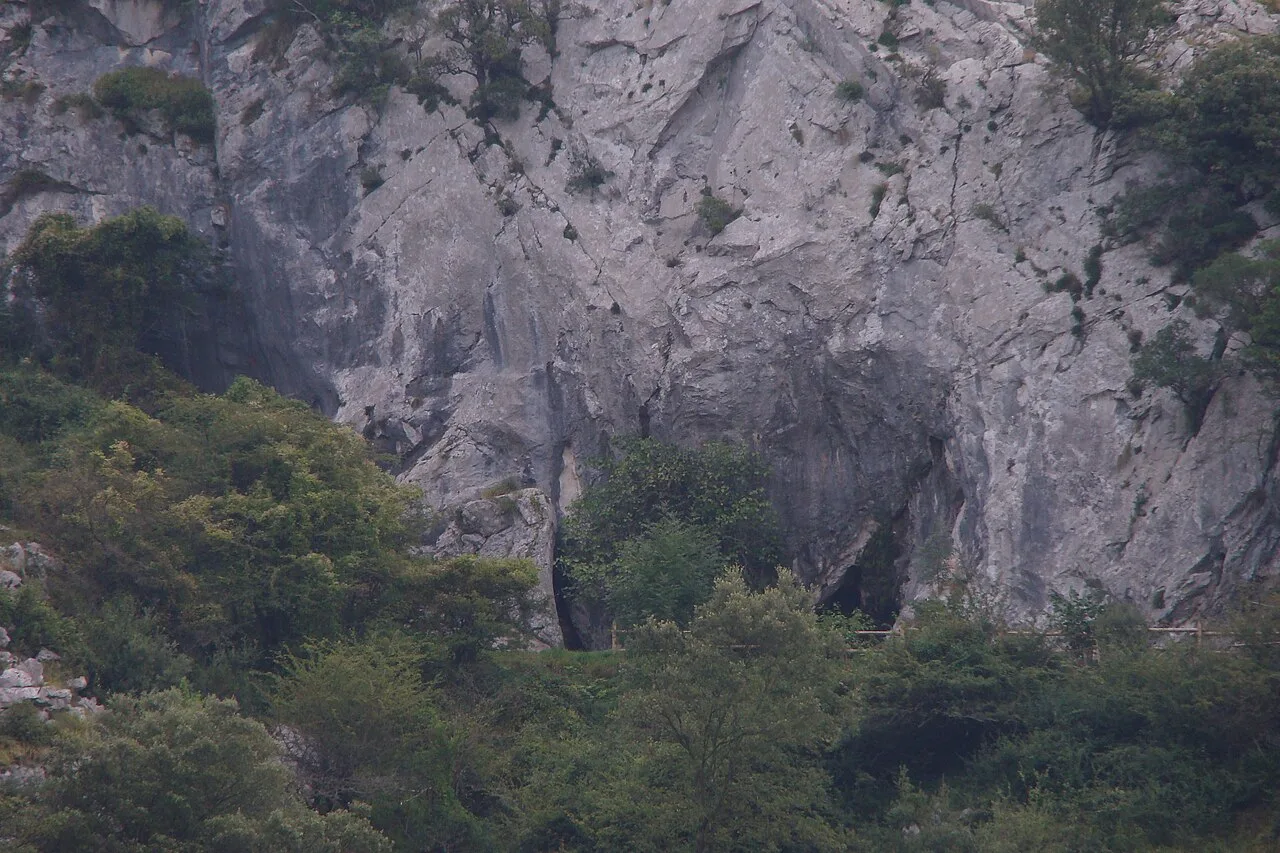
The journey to Covalanas Cave (Cueva de Covalanas) begins long before crossing its entrance. First, you must reach the eastern edge of Cantabria, in the municipality of Ramales de la Victoria, within the Asón-Agüera region. From there, a steep trail climbs on foot up the northeastern slope of Mount Pando.
At our feet opens the narrow valley of the Calera River, which descends toward the Asón River among green meadows, holm oak groves, and gray limestone cliffs. But if we close our eyes and step back some twenty thousand years, everything changes completely.
That era corresponded to the Solutrean, a stage of the Upper Paleolithic (the final phase of the Knapped Stone Age) set right in the Last Glacial Maximum, the coldest period of the last Ice Age. Sea level was more than one hundred meters below present levels, and nearby mountains were capped with perpetual snow. Instead of today's lush woodland, cold grasslands, scrubland, and small pockets of forest sheltered at the bottom of the valleys dominated the landscape, traversed by herds of deer and Iberian ibex.
The cave mouth opens halfway up the slope, like a natural balcony overlooking the valley. Standing there, it is easy to imagine the thrill experienced by its discoverers in 1903. Just one year earlier, the French prehistorian Émile Cartailhac had published his famous article Mea culpa d'un sceptique (1902). In it, he retracted years of skepticism and finally accepted that the paintings of Altamira were authentic Paleolithic artworks.
That shift triggered a true exploration frenzy throughout the Cantabrian Cornice. Two tireless pioneers, the Cantabrian researcher Hermilio Alcalde del Río and the priest Lorenzo Sierra, explored caves and rock shelters across the region by the light of carbide lamps. In that fruitful year of 1903, they ventured into the narrow right-hand gallery of Covalanas.
Suddenly, their light beams illuminated reddish silhouettes that seemed to vibrate upon the stone: they had just found "the cave of the red hinds". Shortly thereafter, alongside the French abbé Henri Breuil, they published their drawings in the classic book Les Cavernes de la Région Cantabrique (1911), which placed Covalanas among the great treasures of European prehistoric art.
Specialists date the paintings of Covalanas to the Upper Paleolithic, predominantly to the Solutrean period, around 20,000 years ago (around 20,000 BP, Before Present). Broadly speaking, its style fits within a window between 20,000 and 25,000 years ago, spanning from the end of the Gravettian (the preceding stage of the Upper Paleolithic) into the Solutrean. Even during the harshest depths of the Ice Age, the Cantabrian Cornice served as a corridor buzzing with life and cultural exchange.
Owing to its exceptional value, Covalanas is protected as an Asset of Cultural Interest (BIC). Furthermore, since 2008 it has been inscribed as a UNESCO World Heritage site, as part of the property Cave of Altamira and Paleolithic Cave Art of Northern Spain. In contrast to the massive polychrome murals of Altamira or the walls filled with overlapping figures in El Castillo, Covalanas stands out for its extraordinary stylistic unity. It is the finest model of red dotted or tamponade painting in the entire Iberian Peninsula: an intimate, serene sanctuary with an unmistakable stroke.
Visual gallery: cave setting and structure
👥 2. The Creators: Characteristics of the Human Population
Leaving the valley sunlight behind, we enter the bright vestibule of the cave. Before heading deeper into the darkness, it is worth asking who climbed this very slope carrying pigments and fire. The artists of Covalanas belonged to our own species, Homo sapiens—anatomically modern humans like us. They formed hunter-gatherer communities of the Upper Paleolithic endowed with full capacity for complex language, abstract imagination, and symbolic art.
In certain caves across the peninsula, debates persist regarding possible very early signs created by Neanderthals (Homo neanderthalensis). At Covalanas, however, there is no ambiguity: its stylized animal figures are unquestionably the handiwork of Solutrean Homo sapiens groups.
They led a semi-nomadic lifestyle closely tied to seasonal rhythms. They organized themselves into small family bands of a few dozen individuals who moved between the coast and inland valleys following animal herds. In the mountains and narrow gorges of the Calera and Asón rivers, they primarily hunted red deer and Iberian ibex, as well as wild horses and wild cattle such as the aurochs. They supplemented their diet by fishing in nearby rivers and gathering wild plants and fruits during milder months.
The Solutrean was also an era of consummate technical mastery in stoneknapping. These groups knapped exceptionally thin flint points—the renowned laurel-leaf points and shouldered points (puntas de muesca)—crafted with an almost sculptural delicacy for ranged hunting in a harsh, cold landscape.
Advancing from the entrance toward the interior reveals how they utilized subterranean space. Early on, the cave branches into two forks: a gallery on the left, devoid of significant paintings, and the narrow right-hand gallery, where figures emerge as soon as daylight fades completely. The most striking aspect is that Covalanas contains virtually no evidence of daily domestic life.
To understand why, one need only look a few meters away along the very same slope of Mount Pando, where the colossal entrance of El Mirón Cave (Cueva de El Mirón) opens up. That cave hosted a major base camp occupied over thousands of years, complete with hearths and lithic workshops. It even yielded a unique ritual burial: the famous "Red Lady of El Mirón," dating to the Magdalenian (the final major cultural stage of the Upper Paleolithic). In contrast to that spacious, bustling cave-home, Covalanas functioned as a secluded sanctuary. It was a narrow passageway entered not for sleeping or butchering game, but for stepping in silence into the mountain's depths.
What meaning did these images hold for those who painted them? While we may never reconstruct their belief system with exact certainty, contemporary archaeological science dismisses naive notions of "art for art's sake." The fact that nearly all figures represent hinds—female deer without antlers, rendered with exquisite delicacy—and that antlered stags are virtually absent points to a deliberate, carefully considered message.
Researchers suggest several complementary interpretations. They highlight notions of fertility and the renewal of life, initiation rites conducted within the gallery, and territorial markers. Indeed, the hinds of Covalanas share an almost identical style with other regional caves—such as La Haza, El Pendo, or Arenaza—a grouping often referred to as the Ramales School. Alongside geometric signs, these paintings may have served as shared emblems reminding different bands that they walked the same territory and shared a common cultural memory.
🖌️ 3. Technical Aspects of the Artistic Depictions
Inside the right-hand gallery, daylight vanishes completely. The corridor narrows so dramatically that visitors must walk in single file, just as their Paleolithic predecessors did. The limestone walls are nearly within arm's reach, and right at eye level, the figures of "the cave of the red hinds" begin their procession.
The assemblage of Covalanas brings together around twenty hinds, one horse, and an aurochs (a massive extinct wild ox, the ancestor of modern domestic cattle). Added to these are several geometric signs, including straight lines and rectangular motifs divided into compartments. All the hinds display a highly uniform style: elongated heads, slender and upright necks, V-shaped ears, and exceptionally well-proportioned bodies. They do not even require fully rendered legs to convey an astonishing sense of vitality.
Among them stands the sanctuary's most celebrated composition: a hind turning its head backward. It turns its neck in a swift gesture of alert, as if it had just heard our footsteps echoing down the corridor. Other hinds appear in rows or small groups moving together. Some face toward the cave depths while others face the exit, creating a veritable narrative route along the gallery.
To paint the entire corridor, the artists chose a single color: red. They obtained it from ochre, a natural mineral pigment rich in iron oxides, primarily hematite. Ground into fine powder, this mineral yields vibrant hues ranging from vivid red to reddish brown. Neighboring caves showcase a broader palette incorporating yellow ochres—such as limonite or goethite, another yellowish iron oxide. Paleolithic artists also frequently employed black pigments derived from wood charcoal or manganese dioxide (a dark mineral widely used in prehistoric art), yet in Covalanas they deliberately avoided them all.
To adhere this powder to the rock, researchers debated for decades what liquids or binders (substances that bind and fix pigment) were employed. Animal fat, plant resins, or egg whites were once hypothesized, but current analyses point to a much simpler solution. In many Cantabrian caves, it was sufficient to mix ochre powder with mineral water from the cave itself—rich in dissolved calcium carbonate—or simply exploit the natural dampness of the wall. As it dried, the pigment integrated directly into the limestone pores, behaving much like fresco painting.
If red defines Covalanas' character, its crowning technical signature is tamponade or dotting (tamponado or punteado). In the Paleolithic, many other techniques coexisted. One was airbrushing or blowing (aerografía), blowing liquid paint from the mouth or through a hollow bird bone, commonly seen in hand stencils. Other artists painted using animal-hair brushes, moss pads, or their bare fingers, or carved into the rock using a flint burin. This small knapped stone tool featured a sturdy, chisel-like tip capable of cutting fine grooves or striated engraving.
In Covalanas, however, engravings and solid color washes are virtually absent. The artists drew every silhouette with rhythmic rows of red dots placed side by side. In some places, the dots are pressed so tightly together that they blend into a soft, somewhat fuzzy contour, which early scholars referred to as a trazo baboso ("slimy" or blurred outline). Most likely, they applied the color using ochre-soaked fingertips or a small pad of animal hide or plant fibers.
The resulting effect is astonishing because it anticipated by twenty thousand years the optical principles of Pointillism and digital pixels. Viewed up close, one sees individual dots; stepping back, the human eye merges them into a vibrant, living silhouette. Furthermore, the painters skillfully exploited natural fissures, ridges, and convexities in the rock to define the backline, chest, or groundline, making the animals appear to emerge organically from the stone itself.
All these figures were conceived to be experienced under firelight. In utter darkness, artists worked with stone lamps or torches of resinous wood, such as juniper or pine. The lamps consisted of small hollowed cobbles or slabs of sandstone and limestone filled with animal marrow or tallow and fitted with a plant wick, providing a steady, low-smoke flame. As warm flames moved along the narrow corridor, raking light swept across the rock relief, causing the red dots to shimmer. The hinds appeared to breathe, turn their heads, and run alongside the visitor, evoking an ancient, subterranean precursor to cinema.
Visual gallery: figures, panels, and artistic documentation
🔬 4. Archaeological Analysis and Dating Techniques
Standing before the hind that looks backward, anyone naturally wonders: how do scientists know that these red lines are some twenty thousand years old? Dating parietal art (art painted or engraved directly onto the walls and ceilings of a cave) is one of archaeology's greatest challenges, as the applicable method depends strictly on the material used.
The best-known technique is Radiocarbon Dating by AMS (Accelerator Mass Spectrometry), which functions like an atomic clock capable of measuring tiny samples no larger than a pinhead. However, this method only works on organic matter—that is, remains that were once alive, such as wood charcoal in a black painting or charcoal from a hearth. Because the figures at Covalanas were painted exclusively with mineral red ochre—containing no carbon—they cannot be dated directly using Radiocarbon Dating.
To overcome this limitation in red paintings, archaeologists turn to Uranium-Thorium (U-Th) Series dating. Its principle is straightforward: if we cannot measure the exact age of the paint on a canvas, we can date the thin layer of crystallized mineral crust that accumulated over it.
In caves set within karst landscapes (limestone terrains sculpted by water), dripping water deposits thin crusts of calcite. This crystallized mineral is the same material that forms speleothems, such as stalactites and flowstones. Water carries trace amounts of soluble uranium, but Thorium is insoluble and absent; over time, that uranium decays into thorium at a strictly known rate. By measuring this isotopic ratio, researchers establish the minimum age of the underlying painting—a breakthrough that revolutionized the dating of red rock art in eleven Spanish caves through the seminal study by Pike et al. (2012).
Direct calcite crust dates directly overlying the primary figures at Covalanas remain scarce. Consequently, its Solutrean chronology (around 20,000 years ago) is firmly grounded in stylistic and technical cross-comparison. Its red tamponade hinds share identical diagnostic traits with other well-dated Cantabrian caves—such as El Pendo, La Haza, or La Pasiega. Furthermore, they exhibit striking morphological parallels with hinds engraved on pieces of portable art (decorated portable objects, such as deer scapulae) recovered from securely stratified Solutrean and early Magdalenian layers.
Today, archaeologists examine Covalanas using advanced non-invasive techniques that do not touch or alter the pigment:
- Photogrammetry and 3D laser scanning: creating millimeter-accurate digital twins of the entire gallery. These document every rock contour leveraged by the painters and preserve a permanent digital archive for the future.
- Multispectral photography and DStretch: DStretch is specialized digital decorrelation stretch software that enhances subtle color differences invisible to the naked eye, revealing faint, abraded red dots or figures obscured by thin mineral patinas.
- X-ray Fluorescence (XRF) spectrometry and Raman spectroscopy: projecting low-energy X-rays or laser light directly onto the wall to determine the "chemical fingerprint" of the pigments without removing even a speck of paint.
Finally, painted walls are best interpreted alongside their stratigraphic record. These are the successive soil layers deposited on the cave floor over millennia, much like the pages of a book where the oldest events lie at the bottom. In the floor of Covalanas, virtually no residential occupation remains were preserved. By contrast, excavations at neighboring El Mirón Cave have uncovered thousands of flint tools, deer and ibex bones, hearths, and burials. Thanks to those discoveries, we can reconstruct the everyday life of the very same families who, twenty thousand years ago, traversed the slope of Mount Pando to enter the quiet red sanctuary of Covalanas.
🛡️ 5. Conservation, Current Challenges, and Conclusion
Before retracing our steps toward the exit, it is vital to reflect on how delicate this millennia-old equilibrium truly is. For twenty thousand years, Covalanas survived thanks to an almost motionless microclimate: stable temperature, near-saturation humidity, and total darkness. Whenever modern visitors enter such a cave, each person inadvertently acts as a small heat and moisture radiator: human respiration releases carbon dioxide (CO₂), water vapor, and warmth.
If this balance is disturbed, dissolved CO₂ can render condensed moisture slightly acidic, gradually dissolving the limestone bedrock or the thin calcite films protecting the paintings. Furthermore, if improper permanent lighting is installed, the greatest nightmare of show caves emerges: the so-called "Green Sickness" (Mal Verde). This refers to an outbreak of microscopic algae, cyanobacteria, mosses, and fungi that proliferate in the presence of artificial light and cause irreversible damage to rock art.
At Covalanas, this vulnerability is heightened by its unique morphology. The painted gallery is exceptionally narrow and contains a very small volume of air, meaning it registers temperature or humidity fluctuations far faster than a spacious chamber. Compounding this is the physical risk of accidental brushing against walls that stand within arm's reach.
Here lies the classic dissemination paradox of prehistoric art. If we seal off all caves entirely, society may lose the emotional connection required to cherish and protect them; yet if we open them without restraint, we destroy the very treasures we hope to share.
Several caves had to be closed to the general public following the impacts of mass tourism in the twentieth century. Today, they are enjoyed through interpretation centers and high-precision scientific replicas, such as the Neocave (Neocueva) of Altamira, a full-scale exact reproduction. Covalanas offers an alternative, highly successful model: strictly controlled visitation. Managed by the Network of Prehistoric Caves of Cantabria (Red de Cuevas de Cantabria) and integrated into the European Cultural Route Prehistoric Rock Art Trails (CARP), the original cave remains accessible, but only through advance booking, in very small groups, and for tightly timed intervals. There is no permanent artificial lighting illuminating the art; instead, trained guides and microclimatic sensors monitor every visit.
We finally exit the narrow gallery. Turning toward the vestibule, daylight dazzles our eyes, and the distant murmur of the Calera valley draws us back into the present. Yet we no longer look upon the slope of Mount Pando in the same way. In there, sheltered beneath the damp turf, live hinds created through delicate touches of red earth still endure. Even amid the harshest winters of the Ice Age, the human mind took an extraordinary leap forward, capturing the fleeting movement of a living animal in a symbolic language that continues to resonate twenty thousand years later.
🎟️ 6. Visits, Tickets, and Access Permits
| Aspect | Practical information |
|---|---|
| Is it open to the public? | Yes, via guided tour with advance booking and a very strict capacity limit (maximum 4 people per session). |
| Where to get tickets or permits | Advance purchase on the official portal of the Network of Prehistoric Caves of Cantabria (cuevas.culturadecantabria.com), where current sessions and schedules can also be checked. |
| Managing body | Department of Culture, Tourism and Sport of the Government of Cantabria (Sociedad Regional de Educación, Cultura y Deporte, SRECD). |
| Educational alternative / Interpretation center | Cullalvera Cave (Cueva de Cullalvera, equipped with walkways in Ramales de la Victoria, tickets at cuevas.culturadecantabria.com), Asón Valley interpretation centers, and the Rock Art Center of Cantabria (Centro de Arte Rupestre de Cantabria, Puente Viesgo). |
Covalanas has one of the smallest capacities in the entire regional network: only four people are admitted per tour, and only a few sessions are offered each day (it is typically closed on Mondays and Tuesdays). For this reason, booking well in advance at cuevas.culturadecantabria.com is virtually essential. Same-day online sales usually close at 9:00 AM; after that time, only unreserved walk-in spots (if any remain) are available on site.
Reaching the cave entrance requires hiking up a steep footpath along the slope of Mount Pando. Allow ample time to arrive comfortably and wear sturdy mountain walking shoes with good grip. To protect the red hinds, the gallery has no permanent electric lighting; guides provide handheld flashlights at the start of the tour. The internal temperature hovers between 10 °C and 13 °C (50 °F–55 °F) year-round, so bringing a warm layer of clothing is recommended.
If tickets are sold out or you wish to extend your day, the spectacular Cullalvera Cave (Cueva de Cullalvera) awaits within the town center of Ramales de la Victoria. It features comfortable footbridges and a larger visitor capacity, and tickets can also be booked at cuevas.culturadecantabria.com. Furthermore, the entrance to El Mirón Cave opens on the very same hillside (closed to tourism), and in Santander, the MUPAC (museosdecantabria.es) rounds out the region's extraordinary Paleolithic story.
📚 References and Consulted Documentation
- Alcalde del Río, H., Breuil, H. y Sierra, L. (1911): Les Cavernes de la Région Cantabrique (Espagne), Mónaco, Imprimerie Vve. A. Chêne (first scientific documentation of the red hinds of Covalanas).
- Barandiarán, I., Martí, B., Rincón, M.ª A. del y Maya, J. L. (2012): Prehistoria de la Península Ibérica, Barcelona, Ariel.
- Bueno Ramírez, P. y Balbín Behrmann, R. de (coords.) (2009): El arte prehistórico en la Península Ibérica, synthesis studies in Munibe / Universidad de Alcalá.
- Cartailhac, É. (1902): «Les cavernes ornées de dessins. La grotte d'Altamira, Espagne. "Mea culpa" d'un sceptique», L'Anthropologie, 13, pp. 348–354.
- García Díez, M. y Eguizábal Torre, J. (2003): La Cueva de Covalanas. El grafismo rupestre y la definición de territorios gráficos en el Paleolítico cantábrico, Santander, Ayuntamiento de Ramales de la Victoria / Consejería de Cultura, Turismo y Deporte del Gobierno de Cantabria.
- González Sainz, C., Cacho Toca, R. y Fukazawa, T. (2003): Arte Paleolítico en la Región Cantábrica, Santander, Universidad de Cantabria / Gobierno de Cantabria.
- Montes Barquín, R. y Sanguino González, J. (dirs.) (2001): La Cueva de El Pendo. Actuaciones arqueológicas 1994–2000, Santander, Gobierno de Cantabria.
- Pike, A. W. G., Hoffmann, D. L., García-Diez, M., Pettitt, P. B., Alcolea, J., De Balbín, R., González-Sainz, C., de las Heras, C., Lasheras, J. A., Montes, R. y Zilhão, J. (2012): «U-Series Dating of Paleolithic Art in 11 Caves in Spain», Science, 336 (6087), pp. 1409–1413.
- Sanchidrián Torti, J. L. (2001): Manual de arte prehistórico, Barcelona, Ariel Prehistoria.
- Straus, L. G., González Morales, M. R., Carretero, J. M. y Marín-Arroyo, A. B. (2015): «"The Red Lady of El Mirón". Lower Magdalenian life and death in Oldest Dryas Cantabrian Spain: an overview», Journal of Archaeological Science, 60, pp. 134–137.
- UNESCO World Heritage Centre: Official file no. 310 (Cave of Altamira and Paleolithic Cave Art of Northern Spain, 1985/2008).
- Ministerio de Cultura (España) y Museo Nacional y Centro de Investigación de Altamira: World Heritage catalog and documentary archives (cultura.gob.es).
- Red de Cuevas de Cantabria: Official technical sheets, conservation protocols, and access regulations.
- Cultural Route of the Council of Europe — Prehistoric Rock Art Trails (CARP): prehistour.eu.
Official sources for visits, tickets, and permits
- Red de Cuevas Prehistóricas de Cantabria (Gobierno de Cantabria / SRECD): Advance ticket purchase, schedules, and visitor quotas for Covalanas Cave and neighboring Cullalvera Cave (cuevas.culturadecantabria.com).
- Museos de Cantabria — MUPAC (Museum of Prehistory and Archaeology of Cantabria): Regional Paleolithic collections and visitor information (museosdecantabria.es).