
Table of contents for this page
- The solar sanctuary of Les Garrigues: ten thousand years of dance, hunting, and promises carved into the sandstone
- 🗺️ 1. Introduction and Contextualization of the Cave
- 👥 2. The Creators: Characteristics of the Human Population
- 🖌️ 3. Technical Aspects of the Artistic Representations
- 🔬 4. Archaeological Analysis and Dating Techniques
- 🛡️ 5. Conservation, Current Challenges, and Conclusion
- 🎟️ 6. Visits, Tickets, and Access Permits
- 📚 References and Consulted Documentation
- Official sources for visits, tickets, and permits
The solar sanctuary of Les Garrigues: ten thousand years of dance, hunting, and promises carved into the sandstone
| Field | Detail |
|---|---|
| Exact location | El Cogul, comarca of Les Garrigues (Lleida, Catalonia), on the left bank of the Set River |
| Chronology | Holocene Post-Paleolithic (Levantine Art and Schematic Art), along with Iron Age and Roman-era inscriptions |
| Discovery | 1908, brought to light by parish priest Ramón Huguet; studied by C. Rocafort, J. Cabré, H. Breuil, and M. Almagro Basch |
| Main techniques | Red, black, and brown pigment applied with fine brushes and fingers; later engraved writing |
| Iconic figures | The "Phallic Dance" scene (nine women in bell-shaped skirts and a male figure), hunting scenes (deer, goats, bulls), and Iberian and Latin inscriptions (Secundio votum fecit) |
| Heritage status / Access | UNESCO World Heritage (Rock Art of the Mediterranean Basin on the Iberian Peninsula, 1998) and BCIN/BIC. Open to visitors with controlled access and an Interpretation Center |
🗺️ 1. Introduction and Contextualization of the Cave
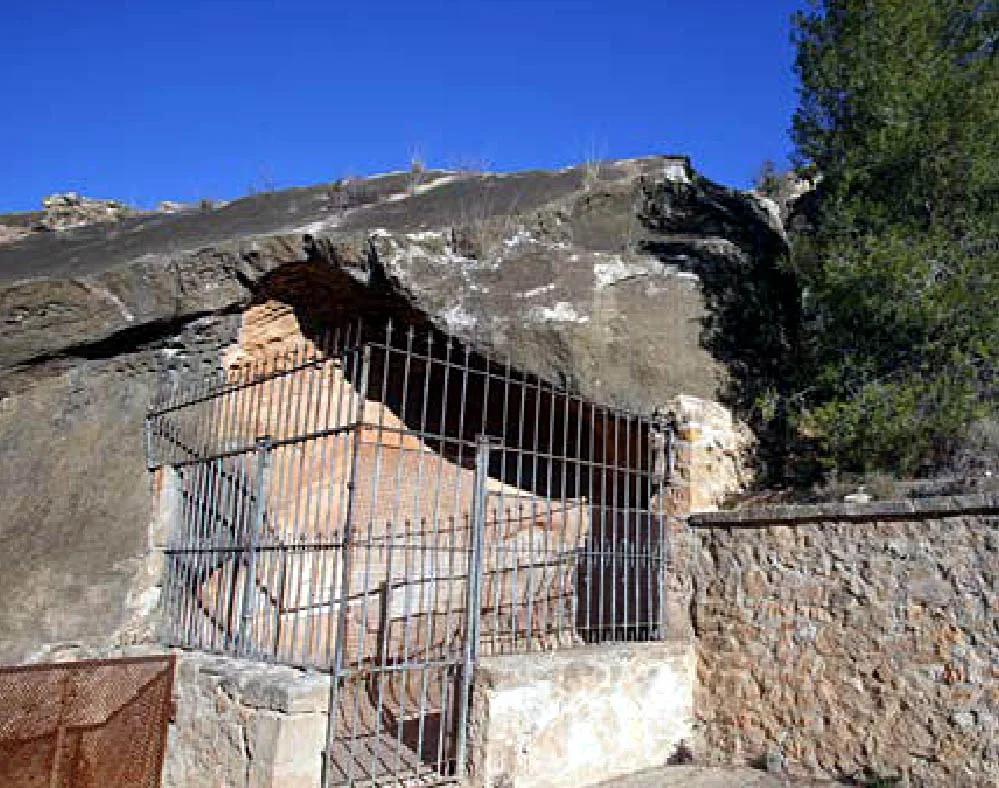
Setting out on foot from El Cogul, a small village in the comarca of Les Garrigues (Lleida, Catalonia), we follow the path leading toward L'Albagés. All around stretches a dry, luminous landscape of olive groves, almond orchards, and Mediterranean scrub. Descending gently toward the left bank of the modest Set River, golden walls of sandstone come into view—a sedimentary rock formed from grains of sand compacted over millions of years. Here, wind and water hollowed out a natural overhang or balma (a shallow rock shelter open to the light): the Roca dels Moros, also known as the Cova del Cogul.
Traveling back to the beginning of the Holocene—the temperate climatic epoch that began roughly 11,700 years ago as the last glacial period drew to a close—the valley of the Set River would surprise us. Free from the biting cold of the Paleolithic (the earliest phase of human prehistory) and without the modern agricultural fields, the shelter overlooked a far greener, more humid landscape. Holm oaks, pines, and lush riparian corridors provided a habitat for red deer, wild goats, and wild cattle (aurochs).
Local residents had known these faint figures for centuries, traditionally attributing them to the "Moors" (moros). However, their scientific discovery did not occur until 1908. The local parish priest, Ramón Huguet, sensed the historic value of the paintings and alerted Ceferí Rocafort of the Centre Excursionista de Catalunya. Two European pioneers of prehistoric art research, Juan Cabré and the Abbé Henri Breuil, soon arrived on site and published the first tracings of the panel. Later, in 1952, Martín Almagro Basch published a landmark monographic study on the shelter and its inscriptions.
The find sent shockwaves through archaeology. Barely six years after mainstream science finally acknowledged Altamira, an open-air art site emerged—vibrant with moving human figures and created after the Ice Age (post-Paleolithic). Today, we know that the Roca dels Moros brings together multiple chapters of history upon a single wall.
Three major horizons coexist here. First is Levantine Art, a style overflowing with narrative movement. Scholars debate whether it originated among the last hunter-gatherers of the Epipaleolithic and Mesolithic (the transitional era following deglaciation) or among the earliest communities of the Neolithic (the first farming and pastoral societies).
Superimposed upon these are figures of Schematic Art, featuring simpler geometric and stylized symbols dating from the late Neolithic, the Chalcolithic (Copper Age), and the Bronze Age. Finally, centuries later, votive inscriptions were added, engraved in Northeastern Iberian script (Iron Age) and in Latin (Roman period).
Designated a Cultural Asset of National Interest (BCIN/BIC), the Roca dels Moros has been a UNESCO World Heritage Site since 1998 as part of the Rock Art of the Mediterranean Basin on the Iberian Peninsula. It represents a unique site in Europe: a single cliff face preserving thousands of years of sacred use, from prehistory through to the Roman world.
👥 2. The Creators: Characteristics of the Human Population
Beneath the golden shadow of the rock overhang, one naturally wonders who painted and engraved this mural. All belonged to our own species, Homo sapiens, yet they were part of vastly distinct societies across millennia.
The creators of Levantine Art experienced the profound environmental transformation of the Holocene. They were semi-nomadic hunter-gatherers, exceptionally skilled with the bow against red deer, wild goats, and aurochs. They either coexisted with or evolved into the earliest Neolithic farming villages dedicated to cereal cultivation and animal husbandry. The authors of the Schematic Art were already sedentary agriculturalists and herders of the advanced Neolithic, the Chalcolithic, and the Bronze Age. Centuries later, these lands were inhabited by Iberian communities and Romanized peoples who continued to revere and treat the sanctuary with respect.
Unlike the grand limestone caverns of the north—where daylight vestibules served as habitation camps and deep, pitch-black galleries functioned as secluded sanctuaries—the Roca dels Moros has a fundamentally different character. Here, we do not descend into the bowels of the earth; instead, we step into a luminous, open-air rock shelter oriented toward the Set River. Even so, it was neither a permanent dwelling nor a cemetery. It served as an open landscape sanctuary: a visible landmark with fine natural acoustics where various groups gathered periodically to perform rituals, seal alliances, and demarcate their territory.
The meaning of its paintings continues to generate deep interest. For decades, the celebrated scene of women encircling a naked man was known as the "Phallic Dance" and interpreted strictly as a fertility rite. Today, gender-informed archaeological approaches and superimposition analyses reveal that the panel is a true palimpsest—a surface akin to a chalkboard written and rewritten by diverse hands over centuries.
The nine women, rendered in different pigments and across distinct phases, highlight the leading role of women in community ceremonies or rites of passage. For their part, the hunting scenes conveyed prowess, collective group identity, and a spiritual kinship with the natural world. The sacred aura of the site endured for so long that, thousands of years later, devout Iberian and Roman worshipers carved their vows directly into the same stone.
🖌️ 3. Technical Aspects of the Artistic Representations
Approaching the main wall, we examine the mural in detail. On the right side, the famous "Phallic Dance" immediately captures attention: nine stylized women, with narrow waists and bell-shaped skirts falling to mid-calf. Many appear in pairs, painted in red and black, surrounding a diminutive naked male figure with prominently accentuated genitalia.
Toward the left and the upper register, lively hunting scenes unfold across the rock. Archery figures, stags with sweeping antlers, agile wild goats, and realistically proportioned bulls mingle with the more abstract strokes of Schematic Art. Looking closer still, texts carved into the bedrock reveal themselves: several inscriptions in Northeastern Iberian script and in Latin. Prominent among them is the celebrated Roman dedication Secundio votum fecit ("Secundio fulfilled his vow").
The Cogul palette stems from a very simple yet highly effective mineral chemistry. The reds and browns derive from natural iron oxides—hematite and ochers ground into an ultra-fine powder, much like cosmetic rouge—while the blacks originate from charcoal or manganese dioxide. Transforming this dry powder into fluid paint required a binder or fixing liquid. While animal fat, tree resin, or egg white were long proposed, modern scientific analyses indicate that mineral water often sufficed. Aided by ambient moisture and native salts within the bedrock, water permanently bound the color into the sandstone pores like a mineral tattoo.
In other prehistoric caves, techniques such as aerography (blowing liquid paint from the mouth or through a hollow bone tube to create hand stencils) or stippling/tamponing (dabbing color with skins or moss) predominate. The Roca dels Moros, by contrast, stands out for its masterly use of the fine brush. Levantine artists employed delicate brushes made from animal hair, feathers, or vegetal fibers to trace crisp, clean contours filled with flat color. In Schematic Art, conversely, broader strokes executed with fingers or coarser brushes became the norm.
Finally, those who incised the ancient epigraphs applied hard points to the sandstone: flint burins (chiseled-edge knapped stone blades) or metal styluses from Iberian and Roman times. Moreover, these artists skillfully integrated natural fissures, hollows, and contours of the rock face to frame and accentuate each composition.
Lighting also sets this sanctuary apart. Paleolithic cave painters worked in utter darkness with marrow-fat lamps or torches whose flickering flames made the cave walls tremble. At Cogul, by contrast, the artists worked primarily under the direct, slanting sunlight that bathes the rock shelter throughout the day. Even so, it is highly likely that hearth fires were lit at dusk to imbue the figures with life and movement during nocturnal ceremonies.
Visual gallery: figures, panels, and artistic documentation
🔬 4. Archaeological Analysis and Dating Techniques
Gazing upon prehistoric paintings and Roman lettering etched into the very same stone, a natural question arises: how do scientists assign dates to rock art without damaging it?
Two primary "atomic clocks" anchor modern archaeology. AMS radiocarbon dating (accelerator mass spectrometry) functions like a microscopic balance. It counts the remaining radioactive carbon-14 atoms within a tiny speck of charcoal, whether from a black pigment stroke or an adjacent hearth.
On the other hand, Uranium-Thorium (U-Th) dating dates crusts of calcite—the whitish mineral that dripping water deposits in limestone caves, forming flowstones or speleothems (stalactites and crusts). The underlying concept is intuitive: it is equivalent to determining the minimum age of a painting by measuring how long a mineral patina has been crystallizing on top of it.
At the Roca dels Moros, however, no definitive direct laboratory dates exist for the painted art. Iron oxides contain no organic carbon for radiocarbon dating, and the exposed sandstone in an open-air setting does not generate thick calcite crusts suitable for U-Th analysis.
Consequently, its chronology is reconstructed by weaving together three fundamental lines of evidence. First, parietal stratigraphy: analyzing which figures were painted over others, much like determining the order in which posters were pasted onto a wall. Second, comparative stylistic analysis with decorated pottery and portable art (small mobiliary objects) reliably dated across the Mediterranean Basin. And third, epigraphy (the study of ancient inscriptions), which securely anchors the Iberian and Latin texts between the Iron Age and the Roman era.
Today, research relies on completely non-invasive methodologies. Photogrammetry and 3D laser scanning yield millimeter-precise virtual twins of the shelter to monitor fracture lines and preserve the site digitally. Multispectral photography and digital color enhancement software such as DStretch act like "color X-ray vision," uncovering faded figures entirely invisible to the naked eye. In addition, portable X-ray fluorescence (pXRF) and Raman spectroscopy devices identify the "chemical fingerprint" of each pigment without touching the rock surface.
These parietal methods are complemented by examining the ground beneath our feet, where the stratigraphic record is preserved. These successive sediment layers are read like pages in a book, with the oldest strata at the bottom and the most recent at the top. River erosion and time have disturbed parts of this deposit; nevertheless, historical excavations such as those led by Martín Almagro Basch recovered flint tools and ceramic sherds that substantiate the periodic, ceremonial use of the site.
🛡️ 5. Conservation, Current Challenges, and Conclusion
As we take leave of the Set River rock shelter, the fragility of this painted wall is immediately apparent. In sealed caves, the primary threat is the "Green Sickness" (mal vert): algae, fungi, and cyanobacteria proliferating due to artificial lighting, heat, humidity, and the carbon dioxide (CO₂) exhaled by visitors. Although the Roca dels Moros is an open-air shelter, it faces comparable hazards: sharp seasonal temperature swings in Les Garrigues, rainwater washing down the rock face, and lichens taking hold in sheltered shadows. Furthermore, internal subefflorescence causes the sandstone to exfoliate and break down into loose grains ("granular disintegration" or sanding).
Nevertheless, the most severe damage in the past was inflicted by humans before modern heritage safeguards were established. For decades, it was common practice to wet the rock face with water to temporarily revive colors for tourists and photographers, as well as pressing paper directly against the rock to trace the drawings. That practice dissolved internal salts, flushed away pigments, and left indelible chalky white stains, alongside historic abrasions and graffiti.
Here emerges the classic heritage paradox: uncontrolled public access destroys a site, yet complete closure alienates society from its own history. El Cogul provides an exemplary balance. The shelter remains open to visitors, but is shielded by a protective enclosure and a raised walkway that keeps groups at a safe distance.
Directly beside it operates the modern Roca dels Moros Interpretation Center. Much like facsimiles and neo-caves (exact replicas built to preserve fragile prehistoric originals), this center utilizes high-resolution reproductions and interactive exhibits to bring every detail close to the visitor without placing wear on the stone.
Departing from the Roca dels Moros, one carries away a profound appreciation for the human mind's quantum leap toward durable visual communication. Between the dancing women of the Holocene and the vow that Secundio inscribed in Latin thousands of years later pulses the very same universal urge: turning a simple cliff of living stone into enduring memory for those yet to come.
🎟️ 6. Visits, Tickets, and Access Permits
| Aspect | Practical information |
|---|---|
| Is it open to the public? | Yes, open to visitors with admission ticket and controlled access to the rock shelter (balma) and the adjoining Interpretation Center. |
| Where to get tickets or permits | Tickets at the Roca dels Moros Interpretation Center; official schedules and rates at patrimoni.gencat.cat/ca/monument/roca-dels-moros, and reservations via phone 672 445 990 or email reservescogul.acdpc@gencat.cat. Scientific research permits at tramits.gencat.cat. |
| Managing body | Agència Catalana del Patrimoni Cultural (Departament de Cultura de la Generalitat de Catalunya). |
| Educational alternative / Interpretation center | The on-site Roca dels Moros Interpretation Center, located right beside the shelter, featuring tracings, panels, and the virtual reality experience "Els ulls de la història". |
The Roca dels Moros is one of the best-equipped rock art sites for public visits in Catalonia. Tickets are purchased at the Roca dels Moros Interpretation Center, at affordable rates (€6 general admission and €4 reduced). The site typically opens in the morning from 10:00 AM to 2:30 PM, Wednesday to Sunday for most of the year, and Tuesday to Sunday during the summer. Afternoon visits and Tuesdays outside summer operate by prior reservation. It is closed on non-holiday Mondays, December 25 and 26, and January 1 to 15, so checking operating hours at patrimoni.gencat.cat before traveling is recommended.
In addition to regulated access to the balma, admission includes the immersive virtual reality experience "Els ulls de la història" (recommended for ages 8 and up). Because capacity per session is limited, booking in advance by calling 672 445 990 or emailing reservescogul.acdpc@gencat.cat is strongly advised, especially for groups or guided tours.
As an open-air rock shelter in the comarca of Les Garrigues, comfortable walking shoes, water, and sun protection during warmer months are essential. Visitors should plan to arrive at least thirty minutes before ticket office closure and observe the painted cliff face from the exterior walkway without crossing the perimeter railing. Researchers requiring close inspection of the panel must request authorization from the Departament de Cultura at tramits.gencat.cat.
📚 References and Consulted Documentation
- Almagro Basch, M. (1952): El covacho con pinturas rupestres de Cogul, landmark monographic study on the paintings and inscriptions of the site.
- Barandiarán, I., Martí, B., Rincón, M.ª A. del y Maya, J. L. (2012): Prehistoria de la Península Ibérica, Barcelona, Ariel.
- Bueno Ramírez, P. y Balbín Behrmann, R. de (coords.) (2009): El arte prehistórico en la Península Ibérica, synthesis studies in Munibe / Universidad de Alcalá.
- Pike, A. W. G., Hoffmann, D. L., García-Diez, M., Pettitt, P. B., Alcolea, J., De Balbín, R., González-Sainz, C., de las Heras, C., Lasheras, J. A., Montes, R. y Zilhão, J. (2012): «U-Series Dating of Paleolithic Art in 11 Caves in Spain», Science, 336 (6087), pp. 1409–1413 (methodological reference for Uranium-Thorium series dating).
- Sanchidrián Torti, J. L. (2001): Manual de arte prehistórico, Barcelona, Ariel Prehistoria.
- UNESCO World Heritage Centre: Official Dossier No. 874 (Rock Art of the Mediterranean Basin on the Iberian Peninsula, 1998).
- Ministerio de Cultura (España): World Heritage Catalog and documentary collections (cultura.gob.es).
- Cultural Route of the Council of Europe — Prehistoric Rock Art Trails (CARP): prehistour.eu.
- Generalitat de Catalunya: Documentation from the Roca dels Moros Interpretation Center in El Cogul (gencat.cat).
Official sources for visits, tickets, and permits
- Agència Catalana del Patrimoni Cultural — Patrimoni Cultural de Catalunya (official site profile, schedules, admission rates, and Roca dels Moros Interpretation Center): patrimoni.gencat.cat/ca/monument/roca-dels-moros
- Generalitat de Catalunya — Trámites del Departament de Cultura (scientific authorizations for research and conservation): tramits.gencat.cat