
Table of contents for this page
- 🗺️ 1. Introduction and Contextualization of the Cave
- 👥 2. The Creators: Characteristics of the Human Population
- 🖌️ 3. Technical Aspects of the Artistic Representations
- 🔬 4. Archaeological Analysis and Dating Techniques
- 🛡️ 5. Conservation, Current Challenges, and Conclusion
- 🎟️ 6. Visits, Tickets, and Access Permits
- 📚 References and Consulted Documentation
- Official sources for visits, tickets, and permits
A descent into subterranean silence where Neanderthals and Homo sapiens painted stone for more than sixty thousand years
| Fact Sheet | Key Data |
|---|---|
| Exact location | Cerro de la Calinoria (Ardales, Guadalteba comarca, Málaga, Andalusia, Spain) |
| Chronology | Middle Paleolithic (more than 65,500 years ago, U-Th dating) – Upper Paleolithic (with subsequent visits up to recent Prehistory) |
| Discovery | 1821 (entrance opened by an earthquake); 1852 (installation of stone stairways by Doña Trinidad Grund); 1918–1921 (identification of cave art by Henri Breuil) |
| Main techniques | Red, yellow, and black painting (blowing/airbrushing, fingers, dabbed pads, and brush), abundant fine engraving, and deliberate use of stalagmitic flows |
| Iconic figures | Over 1,000 motifs across 1.5 km: speleothems stained with red ocher (Neanderthals), hand stencils, panels of dots and bars, hinds looking back, horses, ibexes, and a rare female human figure |
| Heritage status and access | Cultural Heritage Asset (Bien de Interés Cultural, BIC) and member of the Cultural Route of the Council of Europe (CARP). Open to the public in small guided groups under strict conservation control |
🗺️ 1. Introduction and Contextualization of the Cave
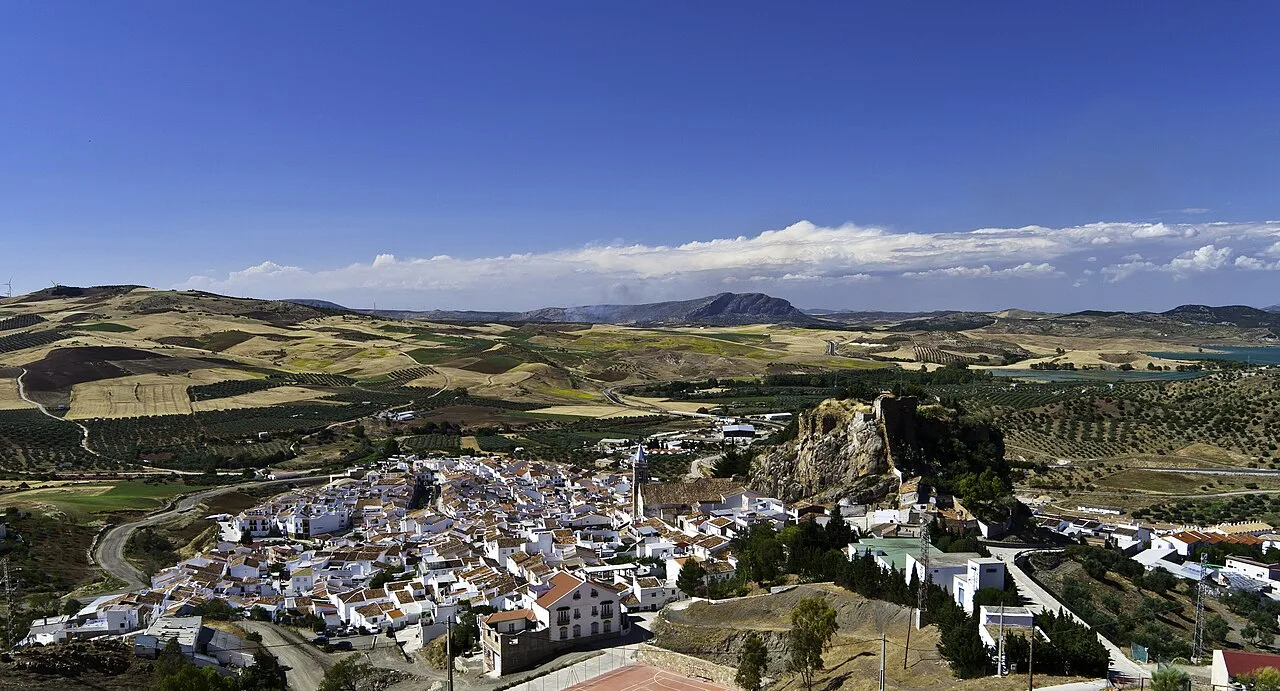
Our journey begins under the inland sun of Málaga, climbing the limestone slopes of Cerro de la Calinoria, some 565 meters above sea level, in Ardales (Guadalteba comarca, Andalusia). From the summit opens a Mediterranean landscape of mountain ranges, olive groves, and pine woods, furrowed by rivers such as the Turón and the Guadalhorce. Nearby lie renowned scenic areas such as the Desfiladero de los Gaitanes and the Carratraca valley.
If we close our eyes and journey back between 60,000 and 15,000 years ago, the environment changes completely. During the last great glaciation of the Late Pleistocene, ice covered northern Europe, but the lands of Ardales acted as a southern climatic refuge. The climate was cooler and more variable, with open slopes of scrubland and pastures, and copses of pines and holm oaks in sheltered valleys. Herds of red deer, wild horses, and Spanish ibex roamed these lands.
That limestone hill concealed within its depths a secret sealed for millennia. Following the final prehistoric visits, several collapses blocked the original entrance, turning the cave into a time capsule. Everything changed in 1821, when an earthquake shook the region, shifting the boulders at the entrance and revealing a dark opening on the hillside.
Thirty years later, in 1852, the Málaga businesswoman Doña Trinidad Grund—closely connected to the nearby thermal spa of Carratraca—purchased the cavern. Fascinated by its chambers, she commissioned stone staircases to allow visitors to tour the interior on excursions illuminated by torches and candles. It thus became one of the first tourist caves in Spain and acquired its famous secondary name.
For decades, no one suspected that those damp walls concealed a treasure far older than their mineral formations. Between 1918 and 1921, the French prehistorian Henri Breuil identified and revealed to the world the Paleolithic paintings and engravings (the chipped stone age). Much later, in 1981, the discovery of the Galerías Altas (Upper Galleries) multiplied the number of known motifs.
Since the mid-1980s, the exemplary study and management of the cave have been directed by Pedro Cantalejo, María del Mar Espejo, and José Ramos (University of Cádiz). They work side by side with international teams led by Gerd-Christian Weniger (Neanderthal Museum in Germany), João Zilhão, and leading specialists in dating and microanalysis.
The history of Ardales spans an astonishing timeline. Its earliest symbolic marks date to the Middle Paleolithic—the era of the Mousterian culture, characteristic of Neanderthals—with minimum dates earlier than 65,500 years ago. Artistic activity then continued throughout the Upper Paleolithic, spanning the Gravettian, Solutrean, and Magdalenian cultures (distinct cultural stages of modern hunter-gatherers). It even witnessed visits and burials during the Neolithic (the earliest farming and pastoral communities) and the Chalcolithic (Copper Age) before becoming permanently sealed.
Declared a Cultural Heritage Asset (Bien de Interés Cultural, BIC) and included in the Council of Europe Cultural Route "Prehistoric Rock Art Trails" (CARP), Ardales stands out on the international stage. It not only hosts one of the richest cave art assemblages in the southern Iberian Peninsula, but is today the world's key evidence demonstrating underground symbolic thinking among Neanderthals.
Visual gallery: surrounding environment and cave structure
👥 2. The Creators: Characteristics of the Human Population
Crossing the entrance and descending the first historic steps, the cool, damp air marks the threshold between two worlds and two humanities. Ardales Cave is not the work of a single human species, but rather the meeting point of two sister lineages separated by millennia. First came the Neanderthals (Homo neanderthalensis) in the Middle Paleolithic. Millennia later arrived modern humans, our own species (Homo sapiens), during the Upper Paleolithic.
The fact that both species chose the same deep chambers to leave their imprint makes Ardales an irreplaceable testament to the evolution of the human mind. Furthermore, it confirms the richness of Neanderthal symbolic behavior in the southern Iberian Peninsula, where the famous geometric engraving at Gorham's Cave in Gibraltar was also uncovered.
Both Neanderthals and Homo sapiens formed small, mobile hunter-gatherer bands, bonded by kinship ties and exchange networks. They hunted red deer in wooded valleys, Spanish ibex on crags, and wild horses in open clearings. They supplemented their diet with small game—such as rabbits—and wild fruits, roots, and plants. Unlike the frozen plains of central Europe, woolly mammoths and reindeer did not dominate here; the milder southern climate enabled stable settlement along transit routes linking the coast and the mountain interior.
Walking from the entrance into the depths, one immediately understands how each zone was used. The entrance vestibule—where natural twilight still reaches and air circulates freely—served for temporary occupations, knapping stone tools, lighting campfires, and, in later prehistoric periods, burying the dead.
Once the last ray of sunlight is left behind, over 1.5 kilometers of underground passages unfold. One traverses spaces such as the Sala del Saco (Chamber of the Sack), the monumental Sala de las Estrellas (Chamber of the Stars), the intricate Galería de los Laberintos (Labyrinth Gallery), El Calvario, and, on an upper level closed to general tourism, the Galerías Altas (Upper Galleries). Nobody conducted daily domestic life back here: total darkness, dampness, and narrow passageways turned the cave's inner sanctum into a sanctuary reserved for symbolism, exploration, and ritual.
Why did they descend with fire into the bowels of Cerro de la Calinoria? Staining large stone formations with color time and again across thousands of years served no practical daily purpose. It was a means of marking a special place in the landscape and imbuing it with shared collective memory. Centuries and millennia later, hand stencils, panels of dots and bars, and animal figures created a symbolic map. These markings guided movement in the darkness, reinforced group cohesion, and conveyed narratives about local fauna, fertility, and their bond with the subterranean heart of the earth.
🖌️ 3. Technical Aspects of the Artistic Representations
As the eyes adjust to the dim light, the rock reveals an astonishing catalog: more than 1,000 motifs distributed across a kilometer and a half of galleries. Many panels constitute an authentic palimpsest—a rock wall painted and reused by successive generations without erasing what came before, like a notebook shared across millennia.
In the Sala de las Estrellas and other grand chambers appears the most famous symbol of Ardales: enormous drapes and formations of speleothems deliberately stained with red ocher. Speleothems are mineral deposits—such as stalactites, stalagmites, and flowstones—formed drop by drop by dripping water over millennia. These are deliberate, abstract marks that converse directly with the natural contours of the stone.
Deeper inside await the signs and drawings of the Upper Paleolithic. One observes hand stencils that seem to greet us from the distant past, alongside large panels of dots and bars that may have served as signals or codes in the subterranean dark. Among the animal figures, hinds feature prominently—some painted with their heads turned, looking back, in a gesture full of vitality—accompanied by slender horses and Spanish ibexes. The assemblage also conceals an exceptionally rare gem: a rare female human figure, an exceedingly scarce subject in European Paleolithic parietal art (paintings and engravings on cave walls).
To apply color inside these chambers, prehistoric artists made use of a palette of three basic tones:
- Reds: obtained from iron oxides, primarily hematite (the mineral of red ocher), remarkably resilient against the passage of time.
- Yellows: derived from more hydrated iron minerals, such as goethite (yellow ocher).
- Blacks: produced with charcoal from burned wood or with minerals rich in manganese dioxide.
For a long time, researchers debated which binders were mixed with these mineral powders to adhere them to the rock wall, proposing recipes containing animal fat, plant resins, or egg whites. Modern analyses demonstrate that something far simpler was often sufficient: calcium-rich mineral cave water, saliva, or the natural moisture of the rock itself. Upon drying, the pigment became fused with the stone like a natural fresco. Furthermore, on the Neanderthal speleothems, the morphology of the pigment splatters indicates that dry or slightly diluted ocher was blown or sprayed onto the uneven rock surfaces.
The techniques and tools employed at Ardales are equally diverse:
- Blowing / airbrushing: artists blew pigment directly from their mouths or through hollow bird bones, functioning like a prehistoric spray. This technique was used to outline hand stencils (using the hand as a stencil) and to spray ocher onto stalagmitic flowstones.
- Fingers, dabbed pads, and brushes: they applied broad strokes with their fingertips and fine lines using brushes made of animal hair or plant fibers. They also employed dabbing (tamponado), pressing their fingertips or a pad of hide or moss against the rock to create alignments of dots.
- Fine engraving and natural reliefs: they engraved numerous hinds, horses, and ibexes using flint burins—stone tools featuring a narrow, extremely hard cutting edge, resembling a miniature chisel. Frequently, artists incorporated natural cracks, fissures, and stalagmitic contours to delineate the backline or belly of an animal, endowing the figures with genuine three-dimensional volume.
None of this would have been possible without mastering fire. Inside Ardales, the darkness is absolute: extinguish your light, and you cannot see your own hand in front of your face. To navigate and paint hundreds of meters from the entrance, they relied on portable limestone lamps—small bowls fueled with bone marrow or animal fat and equipped with plant wicks—alongside resinous wooden torches. The warm flickering flame cast moving shadows across the moist flowstones, making hinds and horses seem to breathe and stir before their eyes.
Visual gallery: figures, panels, and artistic documentation
🔬 4. Archaeological Analysis and Dating Techniques
For nearly a century, establishing the exact age of each painting in Ardales was one of prehistoric archaeology's greatest puzzles. Today, physics, chemistry, and computing have allowed the cavern walls to speak with extraordinary precision.
The breakthrough arrived with Uranium-Thorium (U-Th) dating applied to calcite crusts—the crystalline calcium carbonate mineral that forms the cave's flowstones and draperies. Its underlying principle can be understood through a simple analogy: it is like determining the minimum age of a painting by measuring the age of the petrified layer of mineral dust that coats it. Seeping water from the cave ceiling carries traces of soluble uranium, but practically zero thorium. Once it crystallizes over the painted layer, uranium decays into thorium at a strictly known rate. By measuring the ratio of both elements in a sub-millimetric sample, researchers obtain the minimum age of the underlying pigment.
In 2018, an international team directed by Dirk L. Hoffmann, Alistair W. G. Pike, João Zilhão, José Ramos, Pedro Cantalejo, and Gerd-Christian Weniger published a landmark study in Science. Calcite crusts covering several red-painted draperies at Ardales yielded minimum ages older than 65,500 years ago (consistent with results from La Pasiega and Maltravieso). Because Homo sapiens did not arrive in the Iberian Peninsula until roughly 42,000 to 45,000 years ago, those markings could only have been created by Neanderthals.
As in all rigorous science, the discovery sparked lively methodological debate. Slimak et al. (2018) published critiques in Science, to which Hoffmann et al. (2018) responded with detailed counter-arguments. Some researchers even questioned whether the red color on the stalagmites might have resulted from natural water staining or underground cave clays.
The definitive answer came in 2021 in the journal PNAS. Àfrica Pitarch Martí, João Zilhão, Francesco d'Errico, and the Ardales research team analyzed microscopic pigment samples using Raman spectroscopy, X-ray diffraction, and scanning electron microscopy, comparing them directly against local subterranean clays. The verdict was unambiguous: the mineral composition and grain size showed that the pigment had been brought in from outside the cave. Even more astonishingly, the pigment recipe varied from one spot to another across the large speleothem formation, proving that different generations of Neanderthals returned to paint the exact same symbolic location in separate visits spaced thousands of years apart.
Alongside U-Th dating, Accelerator Mass Spectrometry (AMS) radiocarbon dating provides essential chronological support. It operates like an atomic clock present in all living matter that begins ticking down the moment an animal or plant dies, which modern AMS systems can measure from a microscopic speck of charcoal. However, it can only reach back to approximately 50,000 years ago and applies strictly to organic materials, never to inorganic mineral ochers.
Consequently, at Ardales, U-Th dated the Neanderthal speleothems (older than 65,500 years ago), while AMS radiocarbon dating and stratigraphic excavations dated hearths, organic remains, and Upper Paleolithic archaeological levels. To these methods is now added in Andalusia the archaeology of smoke—the micro-analysis of soot layers trapped within speleothem laminae, applied at Nerja Cave by Medina-Alcaide et al. (2023)—to reconstruct the rhythm and frequency of prehistoric visits.
To investigate the more than one thousand parietal motifs without damaging the fragile rock surfaces, researchers now employ non-invasive archaeological techniques:
- Photogrammetry and 3D laser scanning: creating sub-millimeter "digital twins" that allow faint engravings to be studied in laboratory environments and preserving an archival virtual replica of the cave.
- Multispectral photography and DStretch: pairing sensors sensitive to wavelengths beyond the human visual spectrum with the digital enhancement software DStretch, enabling faded red and yellow markings obscured by calcite to re-emerge.
- X-ray fluorescence (XRF) spectrometry and Raman spectroscopy: analyzing the "chemical fingerprint" of each pigment directly on the cave wall, completely non-destructively without scraping or sampling.
This analytical framework is completed by examining the cave floor. The stratigraphic record—layers of sediment deposited from bottom to top like pages in a buried chronicle—preserves physical evidence from each epoch. Excavations conducted by the University of Cádiz, the Neanderthal Museum, and the Ardales team have uncovered Mousterian and Upper Paleolithic flint toolkits. They have also recovered faunal bones with butchery marks, ocher lumps, charcoal from campfires, and subsequent prehistoric burials that illuminate the lives of those who brought light into these deep passages.
Supplementary documentation: maps, topography, and archaeological record
🛡️ 5. Conservation, Current Challenges, and Conclusion
The journey back toward the cave mouth reminds us just how delicate this subterranean world is. For millennia, its natural sealing preserved a near-perfect subterranean equilibrium: constant temperature, near-saturation humidity, and complete darkness. Whenever humans enter a cave, our breathing releases carbon dioxide (CO₂), water vapor, and body heat. If fixed electrical lighting is left operating, the dreaded "Lampenflora" (Mal Verde) takes root: algae, mosses, fungi, and cyanobacteria that transform moist rock into a greenhouse environment, causing irreversible degradation to cave paintings and fragile calcite crusts.
Unlike other caves damaged by quarrying or 20th-century mass tourism, Ardales offers an inspiring lesson in conservation recovery. Its early tourist opening in 1852 under Doña Trinidad Grund left period-specific interventions, including masonry steps, torch soot, and early visitor graffiti. Since the 1980s, the municipal government and research team have implemented an exemplary conservation plan. They eliminated all fixed electrical wiring—today visitors rely strictly on cold-light portable flashlights carried by the guide—installed continuous environmental monitoring sensors, and strictly minimized visitor numbers.
Ardales response thus demonstrates a thoughtful balance regarding the dissemination paradox: the tension between sealing a cave to ensure its preservation versus opening it so that society values and protects it. Instead of complete closure and the construction of facsimiles (Neocaves)—a necessary measure in more fragile subterranean sanctuaries—Ardales maintains a model of restricted scientific visitation. Tours are conducted in very small groups led by heritage specialists exclusively along designated pathways, while the most vulnerable sectors—such as the Upper Galleries—remain strictly reserved for research. Furthermore, the Ardales Prehistory Center enriches the visitor experience by displaying genuine artifacts and providing cultural context without overtaxing the cave environment.
Stepping back out into the bright daylight of Cerro de la Calinoria and feeling the warm breeze of the Málaga mountains, the surrounding landscape takes on a deeper dimension. Beneath our feet lies one of the profound revelations of modern prehistory: turning silent stone into symbol, memory, and emotion was not unique to our species. More than 65,500 years ago, Neanderthals entered these chambers armed with red ocher, and millennia later Homo sapiens resumed that dialogue with painted hands, hinds, and horses. Together they forged a subterranean bridge proving that the impulse to create meaning in the dark is as ancient as human consciousness itself.
🎟️ 6. Visits, Tickets, and Access Permits
| Aspect | Practical information |
|---|---|
| Is it open to the public? | Yes, via guided tours requiring mandatory advance booking in small groups (maximum of about 15 people per tour). The Upper Galleries (Galerías Altas) remain closed to the general public. |
| Where to get tickets or permits | Advance ticket sales on Giglon and inquiries at ardales.es (tel. +34 952 45 80 46; patrimonio@ardales.es). Research permits must be requested through the Ardales Town Hall and the Regional Government of Andalusia (Junta de Andalucía). |
| Managing body | Ardales Town Hall (Ayuntamiento de Ardales), in coordination with the Ministry of Culture and Sport of the Regional Government of Andalusia and the cave's scientific research team. |
| Educational alternative / Interpretation center | Ardales Prehistory Interpretation Center (Centro de Interpretación de la Prehistoria de Ardales, Avenida de Málaga, no. 1, Ardales), the mandatory starting point for all tours. |
To visit the cave, it is essential to purchase tickets well in advance through the authorized Giglon platform or check available tour slots on the Ardales Town Hall website. Tours typically operate from Tuesday to Sunday, remaining closed on Mondays except on public holidays. Please note that visitors must not travel directly to the cave entrance. The mandatory meeting point is the Prehistory Interpretation Center in the town of Ardales, from which visitors follow the guide's vehicle for approximately four kilometers in their own transport.
The guided tour lasts approximately two hours and explores chambers devoid of fixed electrical lighting, illuminated solely by cold-light portable torches. Visitors are strongly advised to wear closed walking shoes with good grip and a light layer of warm clothing, as the moist cave floor features uneven historical steps. For conservation and visitor safety, children under 8 years of age are not permitted, and photography, video recording, and large backpacks are prohibited. Researchers requiring access for scientific purposes or wishing to examine the Upper Galleries must submit a formal permit request to both the Ardales Town Hall and the Department of Culture and Sport of the Junta de Andalucía.
If you are traveling with young children or tickets are sold out for your preferred dates, the Ardales Prehistory Interpretation Center is an outstanding alternative. Its exhibition halls house original artifacts, high-fidelity reproductions, and explanatory panels detailing daily life and prehistoric art across the Guadalteba comarca without placing ecological pressure on the subterranean cave.
📚 References and Consulted Documentation
- Barandiarán, I., Martí, B., Rincón, M.ª A. del, and Maya, J. L. (2012): Prehistoria de la Península Ibérica, Barcelona, Ariel.
- Bueno Ramírez, P. and Balbín Behrmann, R. de (eds.) (2009): El arte prehistórico en la Península Ibérica, synthesis studies in Munibe / Universidad de Alcalá.
- Cantalejo, P., Maura, R., Espejo, M.ª M., Ramos, J., Medianero, J., Aranda, A., and Durán, J. J. (2006): La Cueva de Ardales: Arte prehistórico y ocupación en el Paleolítico Superior, Málaga, CEDMA.
- Hoffmann, D. L., Standish, C. D., García-Diez, M., Pettitt, P. B., Milton, J. A., Zilhão, J., Alcolea-González, J. J., Cantalejo-Duarte, P., Collado, H., de Balbín, R., Lorblanchet, M., Ramos-Muñoz, J., Weniger, G.-Ch., and Pike, A. W. G. (2018): "U-Th dating of carbonate crusts reveals Neandertal origin of Iberian cave art", Science, 359 (6378), pp. 912–915.
- Cultural Route of the Council of Europe — Prehistoric Rock Art Trails (CARP): prehistour.eu.
- Medina-Alcaide, M.ª Á., Vandevelde, S., Quiles, A., Pons-Branchu, E., Intxaurbe, I., Sanchidrián, J. L., Valladas, H., Deldicque, D., Ferrier, C., Rodríguez, E., and Garate, D. (2023): "35,000 years of recurrent visits inside Nerja cave (Andalusia, Spain) based on charcoals and soot micro-layers analyses", Scientific Reports, 13, 5901.
- Ministry of Culture (Spain): Cultural Heritage Catalog and documentary archives (cultura.gob.es).
- Pike, A. W. G., Hoffmann, D. L., García-Diez, M., Pettitt, P. B., Alcolea, J., De Balbín, R., González-Sainz, C., de las Heras, C., Lasheras, J. A., Montes, R., and Zilhão, J. (2012): "U-Series Dating of Paleolithic Art in 11 Caves in Spain", Science, 336 (6087), pp. 1409–1413.
- Pitarch Martí, À., Zilhão, J., d'Errico, F., Cantalejo-Duarte, P., Domínguez-Bella, S., Fullola, J. M., Weniger, G. C., and Ramos-Muñoz, J. (2021): "The symbolic role of the underground world among Middle Paleolithic Neanderthals", Proceedings of the National Academy of Sciences (PNAS), 118 (33), e2021495118.
- Rodríguez-Vidal, J., d'Errico, F., Giles Pacheco, F., Blasco, R., Rosell, J., Jennings, R. P., Queffelec, A., Finlayson, G., Fa, D. A., Gutiérrez López, J. M., Carrión, J. S., Negro, J. J., Finlayson, S., Cáceres, L. M., Bernal, M. A., Fernández Jiménez, S., and Finlayson, C. (2014): "A rock engraving made by Neanderthals in Gibraltar", Proceedings of the National Academy of Sciences (PNAS), 111 (37), pp. 13301–13306.
- Sanchidrián Torti, J. L. (2001): Manual de arte prehistórico, Barcelona, Ariel Prehistoria.
- Slimak, L., Fietzke, J., Geneste, J.-M., and Ontañón, R. (2018): "Comment on 'U-Th dating of carbonate crusts reveals Neandertal origin of Iberian cave art'", Science, 361 (6408), eaau1371 (and response by Hoffmann et al., 2018, eaau1736).
Official sources for visits, tickets, and permits
- Ardales Town Hall (Ayuntamiento de Ardales) (municipal administration, Prehistory Interpretation Center, and visitor regulations): ardales.es
- Official ticket sales platform (Giglon — Visitas guiadas a la Cueva de Ardales): giglon.com/todos?idEvent=visitas-guiadas-a-la-cueva-de-ardales-malaga
- Regional Government of Andalusia — Ministry of Culture and Sport (Archaeology and Cultural Assets): juntadeandalucia.es/temas/cultura/bienes-culturales/arqueologia.html