
Table of contents for this page
- 🗺️ 1. Introduction and Context of the Cave
- 👥 2. The Creators: Characteristics of the Human Population
- 🖌️ 3. Technical Aspects of the Artistic Representations
- 🔬 4. Archaeological Analysis and Dating Techniques
- 🛡️ 5. Conservation, Current Challenges, and Conclusion
- 🎟️ 6. Visits, Tickets, and Access Permits
- 📚 References and Consulted Documentation
- Official sources for visits, tickets, and permits
A journey from the green slopes of Peñamellera Alta to the great dark wall where Paleolithic hunters superimposed five artistic eras over more than ten thousand years.
| Technical Sheet | Detail |
|---|---|
| Exact location | Llonín, municipality of Peñamellera Alta (Cares Valley, Asturias, Spain) |
| Chronology | Upper Paleolithic: from the late Gravettian to the upper and final Magdalenian (approx. 25,000–11,500 years ago; cal. BP) |
| Discovery | 1971 (Grupo de Espeleología Polifemo of Oviedo; known locally since 1957); studied by M. Berenguer, F. Jordá, J. Fortea, and M. de la Rasilla |
| Main techniques | Linear red painting, black painting, fine engraving, and multiple engraving with striated infill |
| Iconic figures | Over 100 motifs across five phases: female human figure in red, undulating lines (serpentiforms), striated hinds and ibexes, black bisons and horses |
| Status and access | UNESCO World Heritage (2008) and Asset of Cultural Interest (BIC). Closed to the public for conservation |
🗺️ 1. Introduction and Context of the Cave
We leave behind the clear waters of the Cares River to climb the southern slope of the Sierra del Cuera, in the Asturian municipality of Peñamellera Alta, next to the village of Llonín. Today we are surrounded by damp meadows, oak groves, Atlantic mists, and the jagged ridges of the Picos de Europa.
Twenty thousand years ago, however, the environment was cold and harsh. Glaciers covered the neighboring peaks, and the Cantabrian Sea lay more than one hundred meters below its present level, pushing the coastline far to the north. Back then, the valley formed an open steppe corridor, dotted with pines and birches.
Opening into the limestone of the hillside—a karst landscape carved out by water dissolving the rock—the entrance of Llonín Cave was well known locally. Thanks to its stable coolness and constant humidity, local villagers used it for generations as a natural cellar to mature artisanal cheeses, never imagining the sanctuary hidden beyond the entrance.
The scientific discovery took place in 1971, when members of the Grupo de Espeleología Polifemo (from Oviedo) explored the interior—known locally since 1957 by cheesemakers—and found Paleolithic paintings and engravings across a large inclined wall. Magín Berenguer and Francisco Jordá conducted the earliest studies of the art. Later, in the 1980s and 1990s, Javier Fortea Pérez and Marco de la Rasilla (University of Oviedo) directed excavations and analyses that turned Llonín into a benchmark across Europe.
Its artistic history spans almost uninterrupted from the Gravettian and Solutrean to the upper and final Magdalenian, major cultures of the Upper Paleolithic. It extends from 25,000 to 11,500 years ago (~25,000–11,500 cal. BP, where BP stands for "before present" and cal. denotes calibrated calendar years).
It is protected as an Asset of Cultural Interest (BIC) and has been inscribed since 2008 by UNESCO as a World Heritage Site (Cave of Altamira and Paleolithic Cave Art of Northern Spain). Llonín is unique because it brings together five superimposed artistic phases on a single large wall alongside an exceptionally complete sequence of excavated layers in the floor.
👥 2. The Creators: Characteristics of the Human Population
Stepping into the dim light of the vestibule, we tread upon ground inhabited solely by Homo sapiens—modern humans like us. Unlike other Iberian caves where older marks attributed to Neanderthals (Homo neanderthalensis) are investigated, here all the art was created by Upper Paleolithic communities.
These creators lived in small, semi-nomadic bands of hunter-gatherers adapted to the diverse landscape of the Cares-Deva corridor. They followed pronounced seasonal rhythms. They hunted red deer and horses in the valley and on the lower slopes, Iberian ibexes and chamois on the crags of the Sierra del Cuera, and bisons or aurochs in open areas. They supplemented their diet with river fishing, wild fruits, and coastal resources.
Our journey toward the interior mirrors how they divided the cave into two distinct spaces:
- The entrance vestibule and access gallery, bright and well-ventilated, served for daily life: there campfires burned, game was butchered and prepared, and tools of flint, quartzite, and bone were knapped.
- The inner chamber of the Main Panel, plunged into absolute darkness, was reserved as a symbolic sanctuary that could only be entered carrying fire.
Why did they return for over ten thousand years to draw upon the exact same wall? Moving past the outdated notion of simple "hunting magic," today we understand the Llonín panel as a palimpsest. It functions like ancient parchments scraped down to be written on again, where underlying traces remain visible. Drawing new figures over older ones was a conscious way of conversing with ancestors, strengthening group cohesion, and keeping the memory of the valley alive.
Within that symbolic realm, the exceptional red female anthropomorph (a figure with human form) stands out. Compared to the overwhelming predominance of animals, the human silhouette is exceptionally rare in Paleolithic art. For this reason, it is often linked to origin myths, notions of fertility, or the sacred bond between the community and nature.
🖌️ 3. Technical Aspects of the Artistic Representations
Now in the quiet heart of the cave, we illuminate the great Main Panel. This expansive, inclined limestone wall brings together over one hundred figures and signs distributed across five superimposed phases:
- Origins in red (Gravettian / Solutrean): At the base appear linear red paintings and early engravings. Amid dots and undulating lines (serpentiforms), the singular female human figure in red stands out, almost unique in Cantabrian parietal art (art on cave walls).
- Heyday of striated engraving (Lower and Middle Magdalenian): Partially overlying the red figures are striking hinds and ibexes, alongside red deer, executed using multiple-stroke engraving with striated shading infill. This is the hallmark of the Astur-Cantabrian Magdalenian. It consists of repeatedly scratching the neck, jaw, and chest with bundles of ultra-fine parallel lines, achieving an impression of fur and volume worthy of a Renaissance engraving.
- Naturalism in black (Middle and Upper Magdalenian): Crowned at the top of the sequence are bisons, horses, and aurochs in black paint, at times combined with fine engraving, featuring highly realistic proportions and meticulous anatomical details.
The color palette made use of local minerals. Reds were derived from crushed iron oxides, particularly hematite (red ocher), and blacks from charcoal from hearths or from manganese oxides (a dark mineral). Regarding binders and solvents—substances used to fix the pigment—current studies correct the classical notion that mixtures with animal fat, resins, or egg white were necessary. Modern analyses demonstrate that mineral water from the cave, rich in calcium carbonate, or the rock's own natural moisture was often sufficient. In this way, the color was sealed like a fresco painting, without ruling out fats or marrow for specific strokes.
Other caves are renowned for spray-painting / stenciling (blowing pigment through a hollow bone to outline hand stencils) or extensive tamponing (dabbing with pelts and moss). Llonín, by contrast, excels through three distinctive resources. It employs direct linear painting (using fingers, fiber brushes, or mineral crayons) and fine and multiple striated engraving carved with flint burins (small knapped stone chisels with a beveled tip). To this it adds the use of natural limestone reliefs to lend volume to backs and bellies.
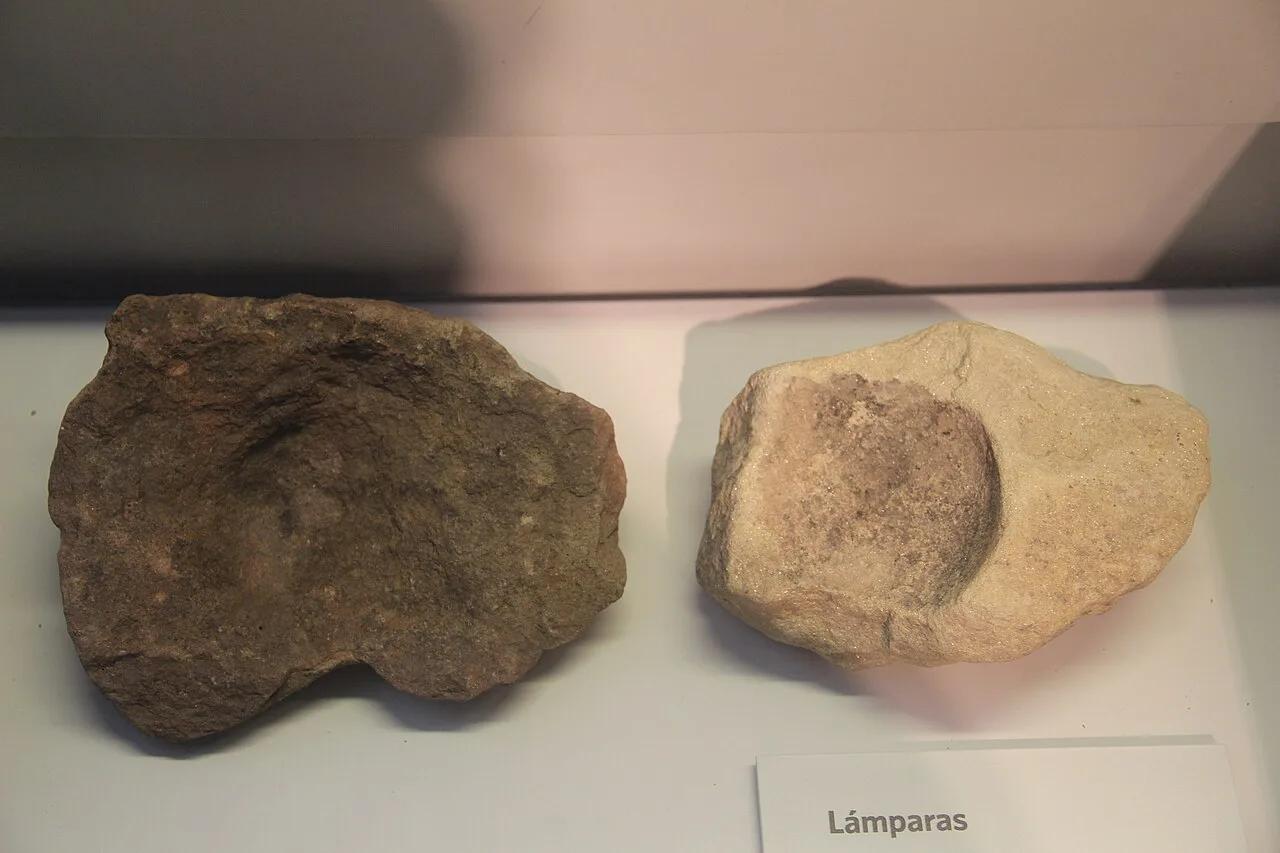
Everything was created in absolute darkness by the light of stone lamps fueled with marrow or animal fat and resinous wood torches. Unlike a modern fixed spotlight, the flickering flame cast shifting shadows across the engraved striations and wall reliefs, breathing life and motion into the animals.
Visual gallery: figures, panels, and artistic documentation
🔬 4. Archaeological Analysis and Dating Techniques
To date the five phases of the panel, archaeology combines chemical clocks, digital tools, and stratigraphic excavation of the floor.
The two primary methods in Paleolithic art are:
- AMS Radiocarbon (Carbon-14) (Accelerator Mass Spectrometry, which counts radioactive atoms in pinhead-sized samples). It works like an atomic hourglass that begins emptying when the wood burned for charcoal or the hunted animal dies. This allows researchers to date both charcoal-drawn paintings and organic remains from the cave floor.
- Uranium-Thorium (U-Th) dating on calcite crusts, namely thin layers of calcium carbonate deposited by dripping water that form speleothems (stalactites and mineral flowstones). It is equivalent to calculating the minimum age of a painting by measuring the chemical age of the mineral dust crystallized over it—a crucial method across many Cantabrian caves (Pike et al., 2012).
It is worth emphasizing that the chronology of Llonín Cave rests on three solid, converging lines of evidence. First, radiocarbon dates and the study of excavated layers in the floor. Second, the physical stratigraphy of the Main Panel, where the five phases intersect and superimpose in an indisputable sequence. Third, comparison with portable art (or mobiliary art: portable objects engraved on bone, antler, or stone). These pieces appear in dated strata from Llonín and neighboring Cantabrian caves, featuring identical striated hinds characteristic of the Lower Magdalenian.
To these are added non-invasive techniques that protect the wall. Photogrammetry (3D models generated from photographs) and 3D laser scanning create a millimeter-accurate "digital twin" to inspect striations under virtual lighting without heating the rock. Multispectral photography and DStretch digital processing act like "color-enhancing lenses" that retrieve faded red lines almost obliterated under calcite. Finally, Raman spectroscopy and X-ray fluorescence (XRF) read the "chemical fingerprint" of each pigment without damaging the painting.
This research culminates in the excavation of the stratigraphic record: layers of sediment stacked like the tiers of a cake, with the oldest at the bottom and the most recent on top. Fortea and de la Rasilla excavated in the gallery and the rear cone levels from the late Gravettian and Solutrean occupations (featuring shouldered points and unifacial points). Above them appeared the key phase of the archaic Magdalenian or Badegoulian (level III) and a rich sequence of layers extending through the upper and final Magdalenian. Among their findings are burins, hearths, hunted faunal remains, and portable art that directly connect the inhabitants of the entrance with the artists of the wall.
Supplementary documentation: plans, topography, and archaeological record
🛡️ 5. Conservation, Current Challenges, and Conclusion
Llonín has survived thanks to a stable, cool underground microclimate nearly saturated with humidity. Every person who enters acts as a humid radiator, emitting heat, water vapor, and carbon dioxide (CO₂). This gas increases the acidity of the thin film of moisture coating the limestone, slowly dissolving the rock.
If artificial lighting is also installed, "Lampenflora" (or green sickness) breaks out: algae, fungi, and cyanobacteria whose spores are carried in on clothing and footwear and colonize the rock panels, destroying the pigments. At Llonín, the entrance already endured historical disturbances due to its past use as a cheese cellar and livestock shelter. Today, the extreme delicacy of its red lines and striations beneath karst seepages permits zero risk.
We thus confront the paradox of heritage outreach: raising awareness of the cave helps foster appreciation, yet opening it to tourism would ultimately destroy it. For this reason, Llonín remains closed to the public, reserved strictly for research and environmental monitoring. The answer lies in Neocaves (full-scale scientific replicas), interpretation centers—such as those at Altamira or Tito Bustillo—and 3D digital replicas. Thanks to them, visitors can explore the five phases of the panel with a clarity impossible to achieve inside the cave, without disturbing the actual sanctuary.
Returning to the green daylight of the Cares Valley, the discreet entrance of Llonín seems to blend once more into the mountain. Behind it beats one of the greatest leaps of our species: the moment when the human mind turned dark stone into symbol, shared memory, and enduring art.
🎟️ 6. Visits, Tickets, and Access Permits
| Aspect | Practical Information |
|---|---|
| Is it open to the public? | No. It remains permanently closed to the general public to protect its microclimate and the extreme fragility of its five phases of cave art. |
| Where to get tickets or permits | Exclusive access for scientific, technical, or conservation personnel with prior authorization from the Directorate General of Cultural Heritage of the Consejería de Cultura del Principado de Asturias (asturias.es). |
| Managing body | Consejería de Cultura del Principado de Asturias (Dirección General de Patrimonio Cultural). |
| Educational alternative / Interpretation center | Replicas in La Galería at the Parque de la Prehistoria de Teverga (parquedelaprehistoria.es) and original artifacts at the Archaeological Museum of Asturias (museoarqueologicodeasturias.com). |
Llonín Cave does not sell tickets or admit tourist visits, as any sudden change in humidity, temperature, or carbon dioxide would endanger its delicate red lines and striated engravings. As an Asset of Cultural Interest and UNESCO World Heritage Site, access is restricted strictly to duly justified environmental monitoring, conservation, or scientific research tasks.
Archaeological teams requiring access to study the cave must request express permission from the Consejería de Cultura del Principado de Asturias (asturias.es). Under Asturian regulations, the application requires submitting a detailed scientific research design and proving specialized academic qualifications and experience in rock art. Furthermore, it mandates the implementation of strict preventive measures and the subsequent submission of a comprehensive scientific report detailing the results.
To appreciate the heritage of Llonín without entering the original cave, there are two essential stops in Asturias. In La Galería at the Parque de la Prehistoria de Teverga (parquedelaprehistoria.es), visitors will find scientific reproductions and educational resources dedicated to the great Cantabrian sanctuaries, including Llonín. Meanwhile, the Archaeological Museum of Asturias in Oviedo (museoarqueologicodeasturias.com) preserves and exhibits original items excavated from the cave, such as stone lamps, harpoons, sagaies, and decorated rods. Those exploring eastern Asturias can also complement their visit by touring nearby open caves such as El Pindal or the Tito Bustillo Cave Art Center (centrotitobustillo.com).
📚 References and Consulted Documentation
- Barandiarán, I., Martí, B., Rincón, M.ª A. del, and Maya, J. L. (2012): Prehistoria de la Península Ibérica, Barcelona, Ariel.
- Berenguer Alonso, M. (1979): El arte parietal prehistórico de la cueva de Llonín (Peñamellera Alta), Asturias, Oviedo, Instituto de Estudios Asturianos.
- Bueno Ramírez, P. and Balbín Behrmann, R. de (eds.) (2009): El arte prehistórico en la Península Ibérica, synthesis studies in Munibe / Universidad de Alcalá.
- Fortea Pérez, F. J., Rasilla Vives, M. de la, and Rodríguez Otero, V. (1992–2007): "La Cueva de Llonín (Llonín, Peñamellera Alta)", reports on the 1987 to 2002 fieldwork campaigns in Excavaciones Arqueológicas en Asturias (vol. 2, 1992, pp. 9–18; vol. 3, 1995, pp. 33–43; vol. 4, 1999, pp. 59–68; vol. 5, 2007, pp. 77–86), Oviedo, Consejería de Cultura del Principado de Asturias.
- Fortea Pérez, J. (ed.) (2007): Arte Paleolítico en Asturias, Oviedo, Gobierno del Principado de Asturias / Universidad de Oviedo.
- González Sainz, C., Cacho Toca, R., and Fukazawa, T. (2003): Arte Paleolítico en la Región Cantábrica, Santander, Universidad de Cantabria / Gobierno de Cantabria.
- Pike, A. W. G., Hoffmann, D. L., García-Diez, M., Pettitt, P. B., Alcolea, J., De Balbín, R., González-Sainz, C., de las Heras, C., Lasheras, J. A., Montes, R., and Zilhão, J. (2012): "U-Series Dating of Paleolithic Art in 11 Caves in Spain," Science, 336 (6087), pp. 1409–1413.
- Sanchidrián Torti, J. L. (2001): Manual de arte prehistórico, Barcelona, Ariel Prehistoria.
- UNESCO World Heritage Centre: Official Dossier No. 310 (Cave of Altamira and Paleolithic Cave Art of Northern Spain, 1985/2008).
- Ministerio de Cultura (Spain) and Museo Nacional y Centro de Investigación de Altamira: World Heritage Catalog and documentary archives (cultura.gob.es).
- Arte Paleolítico en Asturias (Gobierno del Principado de Asturias): Official technical sheets, conservation records, and inventory updates.
- Cultural Route of the Council of Europe — Prehistoric Rock Art Trails (CARP): prehistour.eu.
Official sources for visits, tickets, and permits
- Consejería de Cultura del Principado de Asturias (Dirección General de Patrimonio Cultural): Scientific permits and preventive conservation for the closed cave (asturias.es).
- Parque de la Prehistoria de Teverga: Replicas and educational resources in La Galería (parquedelaprehistoria.es).
- Museo Arqueológico de Asturias (Oviedo): Exhibition of original pieces excavated from Llonín Cave (museoarqueologicodeasturias.com).
- Centro de Arte Rupestre de Tito Bustillo: Nearby educational alternative in eastern Asturias (centrotitobustillo.com).