
Table of contents for this page
- 🗺️ 1. Introduction and Contextualization of the Cave
- 👥 2. The Creators: Characteristics of the Human Population
- 🖌️ 3. Technical Aspects of the Artistic Representations
- 🔬 4. Archaeological Analysis and Dating Techniques
- 🛡️ 5. Conservation, Current Challenges, and Conclusion
- 🎟️ 6. Visits, Tickets, and Access Permits
- 📚 References and Consulted Documentation
- Official sources for visits, tickets, and permits
A descent into the limestone depths of the Serra do Ouribio, where the last Ice Age hunters left the only underground record of Paleolithic cave art known in Galicia.
| Technical Sheet | Details |
|---|---|
| Exact location | Parish of Cancelo, Triacastela (comarca of Sarria, Lugo, Galicia) — Serra do Ouribio (Monte Penedo) |
| Chronology | Cave art from the Late Magdalenian / Azilian (around 12,000 years ago; ~12,000 BP, Style V); human occupation from the Mousterian to the Upper Paleolithic |
| Discovery | Parietal art discovered in 2011–2012 by the team from the USC and IPHES led by Ramón Fábregas Valcarce and Arturo de Lombera-Hermida |
| Main techniques | Black charcoal painting (confirmed by FT-Raman), fine and striated superimposed engraving, and the use of natural cracks and reliefs |
| Iconic figures | Over 90 small-format figures across more than ten panels: bison or aurochs (notably Panel I with linear infill), deer, horses, possible carnivores, dots, and lines |
| Status / Access | Property of Cultural Interest (Bien de Interés Cultural - BIC). Closed to the general public for conservation and scientific research |
🗺️ 1. Introduction and Contextualization of the Cave
Our journey begins outdoors, climbing the slopes of the Serra do Ouribio (Monte Penedo), in the parish of Cancelo, within the municipality of Triacastela (Lugo, Galicia). Today, a lush, humid landscape of meadows, oak groves, and Atlantic valleys surrounds us, but beneath the surface lies a geological rarity.
In a Galicia dominated by granites and acidic slates, a narrow band of limestone rock emerges here, like a small white island amidst a sea of granite. Within it, water has sculpted a karst—an underground topography formed by the slow chemical dissolution of limestone. Right in the heart of this limestone belt opens Cova Eirós.
Around 12,000 years ago, in the final stretch of the last ice age (the Lateglacial), the environment was very different. Although the climate was beginning to warm irregularly, the mountains retained snow every winter. The landscape was much more open and cold, dominated by steppe grasslands and small sheltered forests in the valleys.
For years, Cova Eirós was already renowned in paleontology for its abundant bones of the cave bear (Ursus spelaeus). It also held a valuable archaeological sequence recording the presence of Neanderthals from the Middle Paleolithic and Homo sapiens from the Upper Paleolithic (the central and final stages of the Old Stone Age). However, its walls concealed a secret that was difficult to discern: the diminutive size of the motifs, the delicacy of the strokes, and a thin mineral coating camouflaged them until 2011–2012. It was then that the team from the University of Santiago de Compostela (USC) and the IPHES, led by Ramón Fábregas Valcarce and Arturo de Lombera-Hermida, identified the first paintings and engravings.
The discovery reshaped the map of European prehistory, as it was previously believed that the great Franco-Cantabrian artistic region ended in Asturias. Protected as a Bien de Interés Cultural (BIC), Cova Eirós is the first and only Paleolithic cave art sanctuary documented in Galicia and the entire northwestern Iberian Peninsula. Its figures date to the Late Magdalenian and the transition to the Azilian—the culture that brought the Ice Age to a close—around 12,000 years ago (~12,000 BP, standing for Before Present). They fall within the so-called Style V, which marks the shift from classical Paleolithic realism toward more sober and schematic forms.
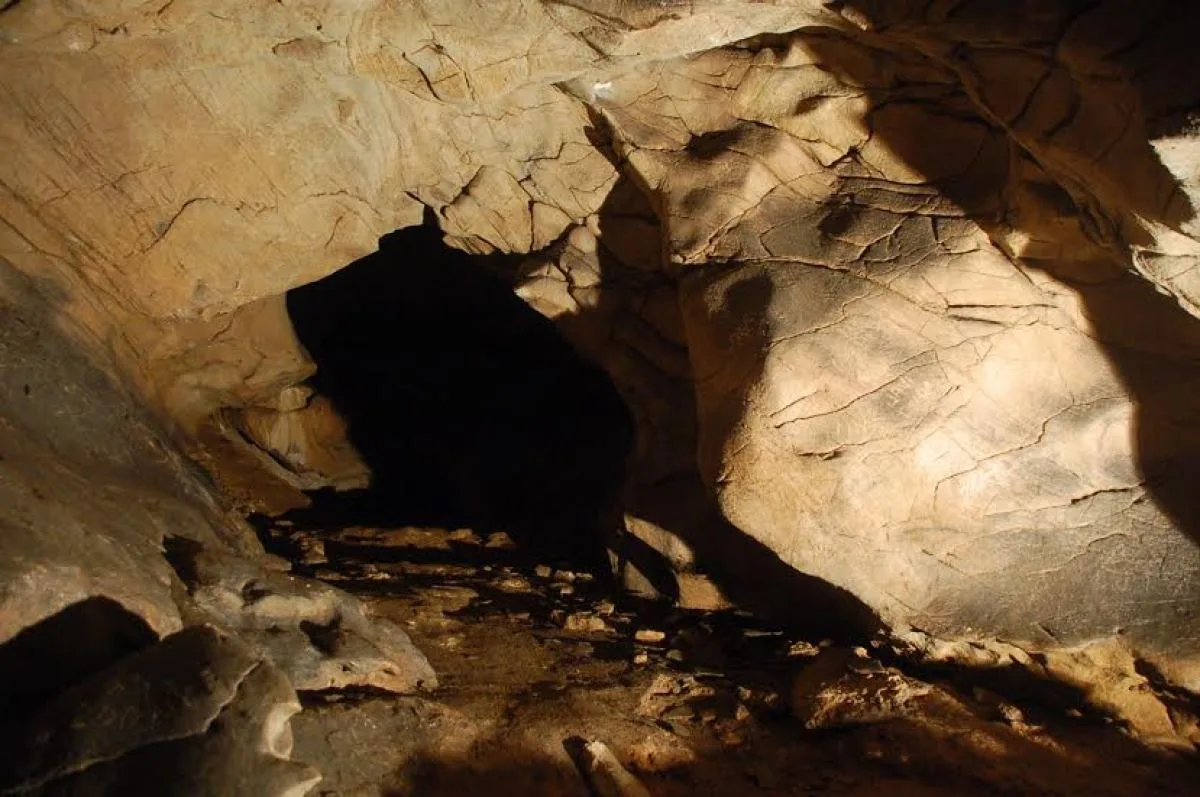
Visual gallery: surroundings and cave structure
👥 2. The Creators: Characteristics of the Human Population
We pause in the vestibule of the cave, the bright and well-ventilated area near the entrance. This ground encapsulates tens of thousands of years of history. It first served as a winter den for cave bears and a shelter for Neanderthals (Homo neanderthalensis). During the Mousterian—the hallmark culture of the Middle Paleolithic—these groups knapped local quartz and lit hearths at this entrance.
Millennia later, after the Neanderthals had disappeared, bands of Homo sapiens—our own species, humans like us—arrived during the Upper Paleolithic. They are the true creators of the parietal art (paintings and engravings on the rock walls) awaiting deeper inside.
The people who decorated Cova Eirós at the end of the Magdalenian and the beginning of the Azilian lived in small, mobile (nomadic or semi-nomadic) hunter-gatherer bands. They hunted large herbivores such as red deer, wild cattle (aurochs) or bison, and horses—precisely the animals depicted on the rock. They supplemented their diet with wild plants and fishing in the rivers of mountain ranges that were beginning to thaw as the glaciers retreated. Because good-quality flint was scarce in the area, they skillfully knapped local quartz and quartzite to manufacture points and scrapers, reserving imported flint for their finest tools.
Taking a few steps inward reveals a stark contrast in the use of space. The sunlit vestibule gathered daily life: cooking, knapping stone, preparing hides, and seeking shelter from the cold. Moving deeper into the dark galleries, however, everyday domestic remains vanish, and the cave turns into a sanctuary: a silent, secluded space set apart from mundane routines.
The exact meaning of these images remains open to debate, but science rules out mere decoration. In a border territory between the Cantabrian coast, the Central Plateau (Meseta Central), and the Atlantic fringe, those schematic silhouettes and clusters of dots likely served to bind the group together and preserve their shared memory. They may also have been part of rituals tied to the subterranean realm or served to mark territory symbolically during an era of profound climatic changes.
🖌️ 3. Technical Aspects of the Artistic Representations
Leaving the exterior daylight behind, we step into the gloom until reaching the inner chamber. Concentrated primarily on the west wall, more than ten panels featuring over 90 small-format figures await us.
In contrast to the large, polychrome figures found in other Cantabrian caves, Cova Eirós displays an intimate and austere style. Bovids (bison or aurochs) appear—such as the celebrated figure on Panel I, notable for its internal infill of parallel lines, highly characteristic of the end of the Paleolithic—along with deer, horses, and possible carnivores. Many silhouettes are schematic or incomplete (heads, backlines, or forequarters), accompanied by numerous dots and series of lines.
In other Paleolithic caves, the palette combined iron oxides (hematite or red and yellow ochres), iron-rich clays, or manganese dioxide (a black mineral). In Cova Eirós, by contrast, black charcoal painting dominates almost exclusively. Regarding binders—the fixing substances—there is a lively ongoing debate. In contrast to older theories that envisioned complex recipes with animal fat, resins, or egg white, many specialists believe that drawing directly with a charred wooden stick was sufficient. They could also mix crushed charcoal with mineral water, taking advantage of the natural rock moisture, much like drawing with charcoal on a slightly damp slate.
Other Paleolithic caves employed varied painting techniques, such as simple brushes or stippling / tamponing (applying color through dabbing with fingers, moss, or hides). Blowing / aerography was also common: blowing paint from the mouth or through a bone tube, characteristic of hand stencils. In Cova Eirós, however, there is neither blowing nor finger tracing on soft clay.
Here, the artists combined black charcoal drawing with an extraordinary fine, striated engraving (very thin parallel strokes). They executed this using flint burins, knapped stone tools with a sharp chisel-like tip. These engravings are frequently superimposed on paintings to reinforce contours or form true palimpsests: figures drawn over one another on the same panel, like a notebook reused multiple times. Furthermore, they made sensitive use of the natural cracks and reliefs of the limestone to suggest backlines, legs, and anatomical volume.
Everything was created in absolute darkness, under the glow of resinous wood torches—which could instantly provide charcoal on the spot—and portable stone lamps fueled by marrow or animal fat with a vegetable wick. Under that flickering flame, the shadows cast by the rock crevices came alive, making the silhouettes on the west wall seem to vibrate.
🔬 4. Archaeological Analysis and Dating Techniques
We now turn modern scientific instruments upon these panels to decipher their age and composition without even touching the stone. To date rock art, two primary natural clocks are mainly employed:
- Radiocarbon dating by AMS (Accelerator Mass Spectrometry): every living organism absorbs radioactive carbon during its life and loses it at a constant rate upon death. AMS acts as an atomic counter capable of dating a speck of charcoal the size of a pinhead. In Cova Eirós, the art is dated to the Late Magdalenian / Azilian (around 12,000 years ago, ~12,000 BP). This chronology is rigorously supported by AMS dates from associated archaeological layers within the cave and its stylistic alignment with Style V.
- Uranium-Thorium (U-Th) dating: this method dates speleothems—mineral formations deposited drip by drip by water, such as thin crusts of calcite (crystallized calcium carbonate)—that cover some of the paintings. The rationale is simple: it is equivalent to calculating the minimum age of a painting by measuring the antiquity of the crystallized mineral dust layer that formed over it. U-Th has revolutionized the study of caves with thick mineral crusts, much like fuliginochronology / smoke archaeology (which analyzes micro-layers of soot trapped in calcite to count visits at other sites). In Cova Eirós, however, the primary chronology relies on associated radiocarbon dating and stylistic analysis.
To analyze the markings in a non-invasive manner, FT-Raman spectroscopy proved essential. A harmless laser beam focuses on the drawing and measures how light scatters, returning the "chemical fingerprint" of each molecule without taking any physical sample. This confirmed that the black pigment was wood charcoal, using a principle complementary to X-ray fluorescence (XRF), which is commonly used for mineral pigments.
Added to this are photogrammetry and 3D scanning, which create millimeter-accurate digital twins of the panels. Multispectral photography paired with the DStretch digital plugin is also used, revealing faded strokes or figures concealed beneath thin veils of calcite.
Finally, everything gains full context thanks to the excavation of the stratigraphic record in the vestibule: the successive layers of sediment, ash, and bone stacked like the orderly pages of an underground book. From these strata come the Mousterian and Upper Paleolithic tools, hearths, charcoals, and remains of Ursus spelaeus and hunted prey that illuminate who entered the cave to paint.
🛡️ 5. Conservation, Current Challenges, and Conclusion
We begin our journey back toward daylight, understanding why we must exit in silence. A Paleolithic cave is a fragile crystal ecosystem that has preserved its artwork for twelve thousand years thanks to near-constant temperature and humidity.
Every visit disrupts that balance: human respiration releases carbon dioxide (CO₂), water vapor, and heat. If artificial lighting is additionally introduced, the dreaded "Green Sickness" (Maladie Verte) erupts—colonies of algae, fungi, mosses, and cyanobacteria that damage the pigments—while moisture turns acidic, dissolving the calcite. This endangers both the delicate charcoal pigment and the moonmilk (mondmilch), a soft, white paste of calcareous microcrystals that is exceptionally vulnerable to the slightest touch.
Beyond these internal risks, Cova Eirós faced a critical external threat: the proximity of an industrial limestone quarry operated by the Cosmos cement company, located between Triacastela and O Incio. Blasting, vibrations, and potential disruptions to subterranean water flows within such a narrow limestone pocket sparked a protracted heritage dispute. Mobilization by scientists and local citizens proved instrumental in securing its legal protection as a BIC.
This gives rise to the dissemination paradox: we must share this treasure so society values and protects it, yet opening it to mass tourism would destroy it. For this reason, Cova Eirós remains closed to the general public and reserved exclusively for scientific research. The answer lies in 3D models, museum exhibitions, and the model of Facsimiles / "Neocaves", such as the exact replicas at Altamira or Ekainberri. In this way, prehistoric art is brought closer to everyone without endangering the original.
Standing once again beneath the open sky of the Serra do Ouribio, Cova Eirós imparts a profound lesson. Even on the Atlantic fringe of Europe and in the dying moments of the Ice Age, the human mind felt the compelling urge to engrave its worldview upon the stone. Thus was born an enduring visual language that continues to speak to us across the millennia from the darkness.
🎟️ 6. Visits, Tickets, and Access Permits
| Aspect | Practical Information |
|---|---|
| Is it open to the public? | No. It remains closed to the general public to protect its charcoal paintings, fine engravings, and the archaeological layers currently under excavation. |
| Where to get tickets or permits | Access is strictly restricted to researchers, archaeologists, and conservation specialists with prior authorization from the Dirección Xeral de Patrimonio Cultural de la Xunta de Galicia (cultura.gal and xunta.gal). |
| Managing body | Dirección Xeral de Patrimonio Cultural de la Xunta de Galicia. |
| Educational alternative / Interpretation center | Museo Provincial de Lugo (museolugo.org) and outreach activities, symposiums, and documentaries sponsored by the Xunta de Galicia, the University of Santiago de Compostela (USC), and IPHES. |
Cova Eirós does not offer ticket sales nor does it allow tourist or independent visits. It is the only known underground Paleolithic cave art sanctuary in Galicia and is protected as a Property of Cultural Interest (Bien de Interés Cultural - BIC). Consequently, the absolute priority is preserving its microclimate, fragile markings, and the excavation floors where Neanderthal and Homo sapiens remains continue to be uncovered.
Any exceptional access for research, digital recording, or conservation requires prior official permission from the Dirección Xeral de Patrimonio Cultural de la Xunta de Galicia (cultura.gal / xunta.gal). Research teams must submit a formal scientific project endorsed by qualified directors, outline non-invasive protection protocols, and comply with Galician cultural heritage legislation.
Currently, there is no on-site replica or visitor center adjacent to the cave in Triacastela. Nevertheless, the public can discover the province's prehistory at the Museo Provincial de Lugo (museolugo.org), which curates and displays archaeological materials from the region. Additionally, the Xunta de Galicia and research teams from the USC and IPHES organize lectures, exhibitions, and documentaries such as O camiño da Cova de Eirós, revealing the interior of the cave without placing it at risk.
📚 References and Consulted Documentation
- Lombera-Hermida, A. de and Fábregas Valcarce, R. (eds.) (2013): Cova Eirós. Primeras evidencias de arte rupestre paleolítico en el noroeste peninsular, Santiago de Compostela, Andavira Editora.
- Steelman, K. L., de Lombera-Hermida, A., Viñas-Vallverdú, R., Rodríguez-Álvarez, X. P., Carrera-Ramírez, F., Rubio-Mora, A., and Fábregas-Valcarce, R. (2017): "Cova Eirós: An Integrated Approach to Dating the Earliest Known Cave Art in NW Iberia", Radiocarbon, 59 (1), pp. 151–164.
- García-Díez, M., Viñas-Vallverdú, R., de Lombera-Hermida, A., Rubio, A., Rodríguez-Álvarez, X. P., Ochoa, B., and Fábregas-Valcarce, R. (2021): "Cova Eirós (Galicia, Spain): The 'Finisterre' of Paleolithic cave art", Journal of Archaeological Science: Reports, 35, 102756.
- Barandiarán, I., Martí, B., Rincón, M.ª A. del, and Maya, J. L. (2012): Prehistoria de la Península Ibérica, Barcelona, Ariel.
- Bueno Ramírez, P. and Balbín Behrmann, R. de (coords.) (2009): El arte prehistórico en la Península Ibérica, synthesis studies in Munibe / Universidad de Alcalá.
- González Sainz, C., Cacho Toca, R., and Fukazawa, T. (2003): Arte Paleolítico en la Región Cantábrica, Santander, Universidad de Cantabria / Gobierno de Cantabria.
- Sanchidrián Torti, J. L. (2001): Manual de arte prehistórico, Barcelona, Ariel Prehistoria.
- Pike, A. W. G., Hoffmann, D. L., García-Diez, M., Pettitt, P. B., Alcolea, J., De Balbín, R., González-Sainz, C., de las Heras, C., Lasheras, J. A., Montes, R., and Zilhão, J. (2012): "U-Series Dating of Paleolithic Art in 11 Caves in Spain", Science, 336 (6087), pp. 1409–1413.
- Medina-Alcaide, M.ª Á., Vandevelde, S., Quiles, A., Pons-Branchu, E., Intxaurbe, I., Sanchidrián, J. L., Valladas, H., Deldicque, D., Ferrier, C., Rodríguez, E., and Garate, D. (2023): "35,000 years of recurrent visits inside Nerja cave (Andalusia, Spain) based on charcoals and soot micro-layers analyses", Scientific Reports, 13, 5901.
- Heritage bodies and repositories consulted: Ministry of Culture of Spain (cultura.gob.es), IPHES, University of Santiago de Compostela (USC), and Council of Europe Cultural Route — Prehistoric Rock Art Trails (CARP) (prehistour.eu).
Official sources for visits, tickets, and permits
- Dirección Xeral de Patrimonio Cultural de la Xunta de Galicia: BIC oversight and exclusive administrative authorizations for scientific research and conservation at Cova Eirós (cultura.gal and xunta.gal).
- Museo Provincial de Lugo: Collections and dissemination of Lugo's prehistory and visitor information (museolugo.org).