
Table of contents for this page
- The Secret Corridor of the Pyrenees: A Twin Sanctuary of Magdalenian Engravings and Gravettian Red Signs in Urdax
- 🗺️ 1. Introduction and Contextualization of the Cave
- 👥 2. The Creators: Characteristics of the Human Population
- 🖌️ 3. Technical Aspects of the Artistic Representations
- Pigments, Color Chemistry, and Binders
- Tools, Engraving, and Color Application
- Illuminating Absolute Darkness
- 🔬 4. Archaeological Analysis and Dating Techniques
- Dating Methods: Atomic Clocks and Mineral Varnishes
- Non-Invasive Archaeology and Digitalization
- Reading the Floor: The Stratigraphic Record
- 🛡️ 5. Conservation, Current Challenges, and Conclusion
- "Green Sickness" and Karst Wounds
- The Paradox of Public Outreach
- Final Reflection
- 🎟️ 6. Visits, Tickets, and Access Permits
- 📚 References and Consulted Documentation
- Official Sources for Visits, Tickets, and Permits
The Secret Corridor of the Pyrenees: A Twin Sanctuary of Magdalenian Engravings and Gravettian Red Signs in Urdax
| Field | Detail |
|---|---|
| Exact location | Municipality of Urdax / Urdazubi (western Pyrenees, Navarre, Spain), within the Berroberría–Alkerdi karst complex |
| Chronology | Upper Paleolithic: Gravettian (c. 28,000–25,000 years ago; ~28,000–25,000 BP) and Magdalenian (Middle and Upper) |
| Discovery | 1930 (Alkerdi I, by Norbert Casteret) / 2014 (comprehensive revision and discovery of Alkerdi II, by the team of Diego Garate and Olivia Rivero) |
| Main techniques | Fine and deep engraving on limestone rock (Alkerdi I and II) and red painting—dots, paired lines, and series of strokes—(Alkerdi II) |
| Iconic figures | Engraved bison, horses, and red deer (Bison Gallery in Alkerdi I) and paired red signs alongside engraved animals (Alkerdi II) |
| Heritage status and access | Bien de Interés Cultural (BIC) (Archaeological Zone). Both caves are closed to the public for their protection; tourist visits available nearby in Ikaburu Cave |
🗺️ 1. Introduction and Contextualization of the Cave
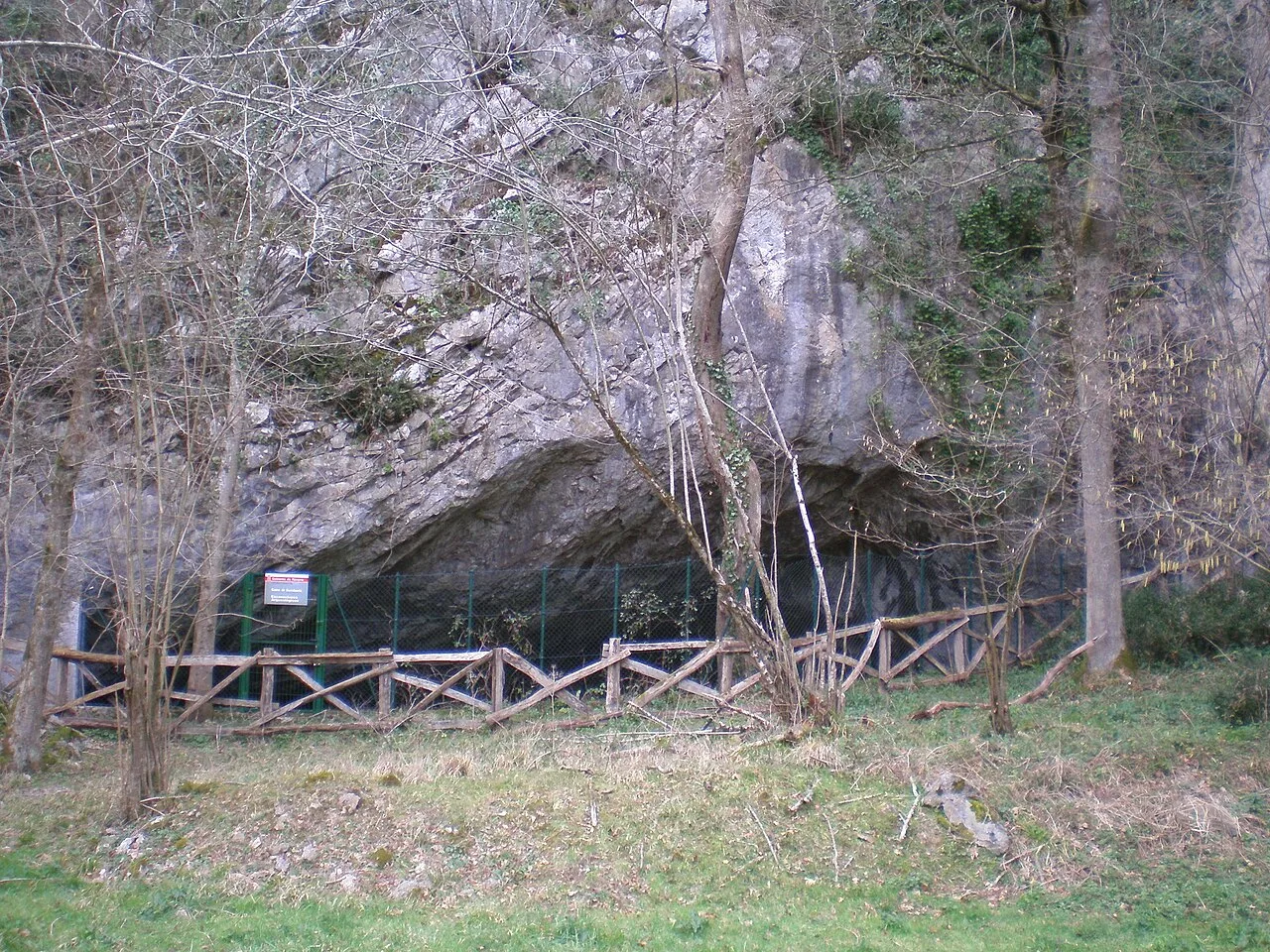
Our journey begins in the open air, at the northernmost, greenest tip of Navarre. We are in the municipality of Urdax / Urdazubi, just steps from the French border. There stretches the Berroberría–Alkerdi karst complex: a subterranean landscape sculpted over millennia as rainwater and streams dissolved the limestone bedrock.
Today this corner presents an Atlantic tableau of lush green meadows, oak groves, beech forests, and soft mists. However, if we turn back the clock between 28,000 and 13,000 years, during the coldest phases of the last glacial period, the landscape becomes unrecognizable. The hillsides were then cold steppes, heathlands, and small stands of pine and birch. Freezing winds swept down from Pyrenees crowned by glaciers far larger than those of today. In that natural pass between southwestern France and the Cantabrian cornice, the rock entrances of Urdax were much more than simple shelters: they opened the gateway to a permanent underground realm.
The modern history of this site began in 1930, almost like an adventure novel. That year, the renowned French speleologist Norbert Casteret—a pioneer in exploring the caves of the Pyrenees—was traveling through the Urdax area and ventured into the narrow passages of Alkerdi I. Under the flickering light of his carbide lamp, he discovered fine incisions on the limestone wall: bison, horses, and red deer engraved during the Upper Paleolithic (the final stage of the Old Stone Age).
For more than eighty years, Alkerdi I remained the only known sanctuary of parietal art—art painted or engraved directly onto cave walls—in all of Navarre. Following Casteret's discovery, scholars as prestigious as Julio Caro Baroja, José Miguel de Barandiarán, and Ignacio Barandiarán studied its walls.
Yet the massif still held its most closely guarded secret. In 2014, a scientific team led by Diego Garate and Olivia Rivero, together with the Aranzadi Science Society, thoroughly re-examined the Alkerdi karst using modern documentation techniques. Those campaigns dramatically expanded the catalog of Alkerdi I: they relocated figures believed to have been lost and revealed a sector christened the Bison Gallery. But the most astonishing discovery lay right next door: they found the neighboring cave of Alkerdi II, an untouched, exceptionally rich sanctuary far older than anyone had imagined.
Thanks to this double window into the past, we know that Alkerdi preserves at least two major stages of the Upper Paleolithic:
- An early Gravettian phase—around 28,000 to 25,000 years ago (28,000–25,000 BP, "Before Present")—captured on the walls of Alkerdi II.
- A second flourishing during the Magdalenian (primarily in its Middle and Upper stages), visible both in the classic engravings of Alkerdi I and in the animal figures of Alkerdi II.
Protected as a Bien de Interés Cultural (BIC), this complex holds irreplaceable scientific value in the Iberian Peninsula. It demonstrates that Navarre was neither an empty nor an isolated territory during the Ice Age. On the contrary, it functioned as the great hinge through which people, artistic styles, and symbols circulated between the French Pyrenees and the Cantabrian region.
Visual gallery: environment and cavity structure
👥 2. The Creators: Characteristics of the Human Population
Leaving behind the daylight outside, we approach the cave mouths of the massif to ask a fundamental question: who stepped inside these galleries? All the artistic and archaeological evidence from Alkerdi I and II belongs to groups of Homo sapiens—that is, anatomically modern humans like ourselves. By the time the first Gravettian red signs were painted some 28,000 years ago, Neanderthals (Homo neanderthalensis) had already vanished from the Pyrenean and Cantabrian realms.
That cold, open landscape shaped every detail of their daily existence. The creators of Alkerdi lived in small hunter-gatherer bands that moved across the land with the seasons. Even so, they were far from isolated: they belonged to wide-ranging social networks that linked neighboring valleys and effortlessly traversed the low passes of the western Pyrenees. They sustained themselves through well-organized hunting of large herbivores—red deer, horses, bison, and Iberian ibex—complemented by fishing in rivers and gathering fruits, roots, and wild plants during the milder months.
One of the most striking aspects of the Urdax complex is the clarity with which its occupants separated daily life from the ritual realm. A short distance from the decorated sanctuaries opens the wide, sunlit, sheltered mouth of Berroberría Cave. There, where sunlight filtered in and hearth smoke could readily escape, they pitched their camps: kindling fires, butchering game, and fashioning stone, bone, and antler tools. Conversely, when seeking a symbolic realm, they departed that luminous vestibule and descended into the dark, damp, narrow passages of Alkerdi I and Alkerdi II. These were not dwellings, but deep sanctuaries reserved for special occasions.
What drove those people to squeeze through tight crawlways just to leave their mark upon the stone? Today, archaeology has moved past simplistic old notions of "hunting magic." Parietal art is now understood as a visual language that reinforced group cohesion, preserved shared cultural memory, and served to demarcate territory. In a strategic corridor linking French Aquitaine and the Cantabrian coast, sharing the same conventions for depicting a bison or arranging rows of red dots strengthened a collective identity and sealed alliances between far-flung bands.
Furthermore, the meticulous study by Olivia Rivero and Diego Garate in Alkerdi II brought to light an extraordinary and exceedingly rare detail in Paleolithic art. Alongside confident strokes executed by master artists, there appear hesitant engravings made by inexperienced hands or "apprentices." This direct evidence of subterranean learning suggests that the Alkerdi sanctuaries also served as spaces to teach artistic craftsmanship and celebrate rites of passage for the youth.
🖌️ 3. Technical Aspects of the Artistic Representations
Switching on our imaginary light, we step first into the galleries of Alkerdi I. The silence is profound, and the cold limestone bears the marks of water and time. Angling the beam of our flashlight almost flush against the wall, the rock springs to life: engraved silhouettes of bison, horses, and red deer from the Middle and Upper Magdalenian suddenly materialize. The bold profiles of the Bison Gallery stand out, where the artist combined firm outlines with delicate details evoking the animal's coat, hump, and sheer power.
Moving next to the neighboring sanctuary of Alkerdi II, the atmosphere shifts, turning more intimate and ancient. On its walls coexist two eras separated by thousands of years, at times superimposed to form a palimpsest—a surface reused multiple times, much like parchment written over scraped-away older text. On the one hand, the Gravettian welcomes us with mysterious motifs in red paint: clusters of dots, paired strokes, and series of lines that stand alongside fine and deep engravings. On the other hand, subsequent visits during the Magdalenian added new engraved animal figures—predominantly herbivores—as well as occasional black drawings.
Pigments, Color Chemistry, and Binders
The contrast between both caves highlights the versatility of the Paleolithic workshop. While Alkerdi I favors pure engraving—where light and shadow sculpt every silhouette without the use of color—Alkerdi II displays the intense red emblematic of the prehistoric mineral palette. That color derives from iron oxides, primarily hematite (commonly known as red ocher), gathered from nearby mineral seams and ground into a fine powder. In Iberian Paleolithic art, this warm spectrum was typically complemented by yellow tones from goethite or limonite and black pigments made of charcoal or manganese dioxide (a highly stable, dark mineral).
For decades, it was assumed that artists mixed these powders with complex recipes involving animal fat, plant resins, blood, or egg whites. However, modern chemical analyses point to a much simpler solution. In most instances, no complex organic residues are detected, and experimental archaeology demonstrates that mineral-rich cave groundwater or the limestone's natural moisture was entirely sufficient. In this way, the iron oxide became a fluid, remarkably durable paint, akin to a mineral watercolor that seeped into the rock pores.
Tools, Engraving, and Color Application
To create their works upon the limestone of Alkerdi I and II, the artists mastered two major techniques:
- Fine and deep engraving: This is the primary technique in both caves. To incise the hard rock, artists used a flint burin, a knapped stone tool with a narrow, sturdy tip resembling a tiny chisel. Depending on hand pressure and wall hardness, they produced both deep, repeated grooves and striated engraving (fine parallel lines that mimic fur or add volume to the animal's body). On softer surfaces, the edge glided smoothly. Furthermore, as seen in other Franco-Cantabrian caves, they took advantage of natural fissures, ridges, and rock contours to suggest backlines, bellies, or anatomical volume with minimal strokes.
- Direct red painting in Alkerdi II: While blow-painting or stencil spraying (blowing liquid pigment from the mouth or through a hollow bone to create hand stencils) was widely used in other Iberian caves, Alkerdi II is dominated by direct techniques. On one hand, dabbing or pad printing (tamponado), which involves gently pressing fingers or a small pad of hide or moss soaked in paint against the wall to generate rows of dots. On the other hand, direct application using fingers, sticks, or rudimentary brushes made of animal hair or plant fibers to render paired marks and linear strokes.
Illuminating Absolute Darkness
None of these figures was ever meant to be seen under the harsh, static glare of modern LED lighting. In the pitch darkness of Alkerdi I and II, artists illuminated their work using portable stone lamps. These were small hollowed-out stone slabs with a plant wick soaked in bone marrow or animal fat, producing a steady, low-smoke flame. They also carried torches of resinous wood such as pine or juniper, especially practical for navigating narrow passages. That warm, dancing orange flame cast moving shadows across the incised lines and natural rock reliefs. To those entering the sanctuary, the bison and horses did not appear motionless: they seemed to breathe, gallop, and emerge directly from the living stone.
Visual gallery: figures, panels, and artistic documentation
🔬 4. Archaeological Analysis and Dating Techniques
We turn now from the gaze of the Paleolithic artist to that of the modern archaeologist. How do we know with scientific rigor that Alkerdi harbors Gravettian works from more than 25,000 years ago alongside much more recent Magdalenian creations, when no one signed or dated the rock wall? The secret lies in weaving multiple disciplines together like pieces of a single puzzle.
Dating Methods: Atomic Clocks and Mineral Varnishes
The study of Paleolithic cave art relies on three primary methods to determine chronology:
- Radiocarbon dating via AMS: AMS (Accelerator Mass Spectrometry) is a highly precise technique that counts individual radioactive carbon atoms in ancient organic remains. It functions as an atomic hourglass that begins ticking when a plant or animal dies, steadily losing grains at a fixed radioactive decay rate. With AMS, a minute sample—no larger than a pinhead—suffices to date drawings rendered in charcoal or torch and hearth residues from the cave floor. However, radiocarbon dating has a clear limitation: it cannot directly date the red iron-oxide pigments of Alkerdi II or rock engravings, because they contain no organic carbon.
- Uranium-Thorium (U-Th) series dating on calcite crusts: As mineral-laden water flows over cave walls, it leaves behind thin crystalline sheets of calcite (calcium carbonate). This is the very mineral that forms speleothems—subterranean features such as stalactites, stalagmites, and flowstones. When a calcite crust grows over a red sign or fills an engraving groove, scientists measure the radioactive ratio between uranium and thorium trapped within the crystal matrix. This is equivalent to calculating the minimum age of a painting by dating the petrified mineral dust deposited on top of it: the artwork must have been executed before that crust formed.
- Contextual, stratigraphic, and stylistic dating (the case of Alkerdi): Determining the age of Alkerdi I and II does not rely on a single isolated test, but on multiple converging lines of evidence. Stylistic comparison clearly connects the paired red marks and certain engravings in Alkerdi II with the Gravettian of the Pyrenees and Cantabria. Concurrently, the engraved bison, horses, and red deer in both caves match the stylistic horizon of the Magdalenian. These dates harmonize with traces of human presence recovered throughout the karst (charcoal fragments and lighting residues) and with well-dated archaeological layers in neighboring Berroberría. Furthermore, innovative methods such as fuliginochronology (the archaeology of smoke—analyzing microscopic soot layers trapped in calcite to chronicle ancient human visits) represent the cutting edge of ongoing research here.
Non-Invasive Archaeology and Digitalization
In just a few years, the team led by Diego Garate and Olivia Rivero revolutionized our understanding of Alkerdi through an essential guiding principle: modern cave research investigates without touching or damaging the rock walls. Photogrammetry—reconstructing the exact three-dimensional topography of the rock from hundreds of overlapping photographs—and high-resolution 3D scanning yield digital replicas accurate to sub-millimeter precision. On these "digital twins," specialists apply traceology (use-wear and microscopic analysis of burin incisions). This reveals the sequence in which lines were drawn, the angle at which the tool was held, and even distinguishes master artists from novice apprentices in Alkerdi II.
To analyze color, researchers use multispectral photography and digital decorrelation enhancement tools such as DStretch. These function as specialized visual filters that reveal faint red pigments or traces obscured beneath calcite coatings that the naked human eye can barely detect. Finally, portable X-ray fluorescence (pXRF) and Raman spectroscopy devices project an innocuous beam onto the paint and measure the secondary energy emitted by its atoms, establishing the "chemical fingerprint" of each ocher recipe without removing a single speck from the wall.
Reading the Floor: The Stratigraphic Record
A sanctuary can never be fully understood by looking at the walls alone. Over millennia, the stratigraphic record accumulates on the floor: successive layers of sediment, ash, and rubble stacked upon one another. They are read like the pages of a book, from bottom (the oldest) to top (the most recent). Across the Berroberría–Alkerdi complex, excavations of these cave floors have unearthed flint tools, bone implements, butchered faunal remains, and hearths. These finds anchor the decorated galleries to the everyday lives of their makers and confirm successive pulses of human occupation throughout the Upper Paleolithic.
🛡️ 5. Conservation, Current Challenges, and Conclusion
We begin our journey back toward the daylight outside. Ahead of us lies the greatest challenge confronting Alkerdi I and Alkerdi II: surviving the twenty-first century after having endured intact for tens of thousands of years.
"Green Sickness" and Karst Wounds
Deep caves are remarkably stable time capsules, maintaining a near-constant temperature and extremely high humidity. When too many visitors enter, their breath releases carbon dioxide (CO₂), body heat, and water vapor. This destabilizes the underground microclimate, potentially dissolving or desiccating decorated surfaces. The risk is even more acute on walls coated in moonmilk (mondmilch), a delicate, soft white microcrystalline paste of calcite that even the slightest brush will permanently destroy. If fixed electric lighting is installed, artificial light and warmth trigger the dreaded "Green Sickness" (maladie verte): invasive blooms of algae, mosses, fungi, and cyanobacteria that stain the rock with greenish patches and obliterate paintings and engravings.
At Alkerdi, however, the most severe recent threat came not from tourism, but from the surface. For decades, limestone quarries operating adjacent to the Alkerdi area subjected the karst massif to vibrations, blasting, and mechanical shocks that caused damage and partial collapses in nearby cavities of the same system. The discovery of Alkerdi II and the widespread realization of its irreplaceable value spurred substantial civic mobilization—championed by grassroots groups such as SOS Alkerdi—and institutional action. That concerted effort led to the review and restriction of quarry operations, legally shielding the site as a Bien de Interés Cultural (BIC) in the category of Archaeological Zone.
The Paradox of Public Outreach
Here lies the fundamental dilemma of all rock art: how can society be inspired to cherish and protect a heritage treasure if, in order to save it, it must remain locked away? In Urdax, the solution has been clear-sighted and exemplary. Both Alkerdi I and Alkerdi II remain strictly closed to the general public. Only authorized specialists enter to monitor the microclimate and pursue ongoing research.
At the same time, right next door, the show cave of Ikaburu (popularly known as the Urdax Caves) allows visitors to explore the geological heart of the very same karst massif without endangering the Paleolithic chambers. Complementing this, Neocaves (exact, life-size replicas open to the public) and interactive 3D virtual tours are proving hugely successful across northern Spain. All of this demonstrates that one does not need to physically tread upon an original sanctuary to be profoundly moved by its story.
Final Reflection
We emerge once more into the cool, verdant air of Urdax. Behind us, beneath the quiet limestone, Alkerdi I and Alkerdi II continue to safeguard nearly thirty thousand years of shared memory. Their masterfully engraved bison, their enigmatic paired red strokes, and even the hesitant incisions of Paleolithic apprentices practicing in the dark are far more than relics of antiquity. They are living testimony to the great cognitive leap of the human mind toward symbolic expression, structured learning, and enduring art. Safeguarding their subterranean silence is the surest way to keep hearing, untainted, the voices of those who once journeyed through this corridor between the Pyrenees and the Cantabrian Sea.
🎟️ 6. Visits, Tickets, and Access Permits
| Aspect | Practical information |
|---|---|
| Is it open to the public? | No. Both Alkerdi I and Alkerdi II remain strictly closed to the general public to protect their fragile engravings, red paintings, and subterranean microclimate. |
| Where to get tickets or permits | Permits are restricted exclusively to scientific research and conservation via prior authorization from the Dirección General de Cultura – Institución Príncipe de Viana of the Government of Navarre (culturanavarra.es and navarra.es). |
| Managing body | Dirección General de Cultura – Institución Príncipe de Viana (Government of Navarre). |
| Educational alternative / Interpretation center | Urdax Caves / Ikaburu (cuevasurdax.com), the museum exhibition space at the Monastery of San Salvador de Urdax, and the Prehistory galleries of the Museum of Navarre in Pamplona (culturanavarra.es). |
Alkerdi I and Alkerdi II Caves are protected as a Bien de Interés Cultural (BIC) under the Archaeological Zone category and do not offer tickets or tourist visits. Their narrow corridors and surfaces coated in moonmilk (mondmilch) could not withstand visitor foot traffic. For this reason, access is reserved exclusively for scientific teams and environmental monitoring personnel with express authorization from the Dirección General de Cultura – Institución Príncipe de Viana (culturanavarra.es / navarra.es).
Travelers journeying to Urdax have the finest alternative just a short distance away to immerse themselves in the same karst massif: the Urdax Caves (Ikaburu Cave). They are open to the public via guided tours lasting approximately 40 minutes amidst stalactites, stalagmites, and the subterranean river Urtxume. It is advisable to purchase tickets in advance through their official website cuevasurdax.com (information telephone: 948 599 241), wear comfortable walking shoes and warm clothing for the constant 14–16 °C interior temperature, and arrive promptly.
To round out the cultural itinerary, the village itself warrants a visit to the architectural ensemble of the Monastery of San Salvador de Urdax, its historic watermill, and the nearby local nature center. Furthermore, if your travels take you through Pamplona, the Museum of Navarre (culturanavarra.es) curates and displays original stone and bone artifacts recovered from the Alkerdi and Berroberría archaeological complex.
📚 References and Consulted Documentation
- Barandiarán, I., Martí, B., Rincón, M.ª A. del, and Maya, J. L. (2012): Prehistoria de la Península Ibérica, Barcelona, Ariel.
- Bueno Ramírez, P. and Balbín Behrmann, R. de (coords.) (2009): El arte prehistórico en la Península Ibérica, synthesis studies in Munibe / Universidad de Alcalá.
- Garate Maidagan, D. and Rivero Vilá, O. (2015): "La 'Galería de los Bisontes': un nuevo sector decorado en la Cueva de Alkerdi (Urdazubi/Urdax, Navarra)," Zephyrus, 75, pp. 17–39.
- Garate Maidagan, D., Rivero Vilá, O., Hermoso de Mendoza, A., Tapia Sagarna, J., Medina-Alcaide, M.ª Á., et al. (2020): "Arte parietal paleolítico de la cueva de Alkerdi 2 (Urdazubi/Urdax, Navarra)," Trabajos de Arqueología Navarra, 31–32, pp. 355–361.
- González Sainz, C., Cacho Toca, R., and Fukazawa, T. (2003): Arte Paleolítico en la Región Cantábrica, Santander, Universidad de Cantabria / Gobierno de Cantabria.
- Medina-Alcaide, M.ª Á., Vandevelde, S., Quiles, A., Pons-Branchu, E., Intxaurbe, I., Sanchidrián, J. L., Valladas, H., Deldicque, D., Ferrier, C., Rodríguez, E., and Garate, D. (2023): "35,000 years of recurrent visits inside Nerja cave (Andalusia, Spain) based on charcoals and soot micro-layers analyses," Scientific Reports, 13, 5901. (Methodological reference on prehistoric illumination and smoke archaeology).
- Pike, A. W. G., Hoffmann, D. L., García-Diez, M., Pettitt, P. B., Alcolea, J., De Balbín, R., González-Sainz, C., de las Heras, C., Lasheras, J. A., Montes, R., and Zilhão, J. (2012): "U-Series Dating of Paleolithic Art in 11 Caves in Spain," Science, 336 (6087), pp. 1409–1413. (Methodological reference on Uranium-Thorium series dating of calcite crusts).
- Sanchidrián Torti, J. L. (2001): Manual de arte prehistórico, Barcelona, Ariel Prehistoria.
- Ministry of Culture (Spain) and heritage documentary archives: Heritage Catalog and official documentation (cultura.gob.es).
- Cultural Route of the Council of Europe — Prehistoric Rock Art Trails (CARP): prehistour.eu.
Official Sources for Visits, Tickets, and Permits
- Dirección General de Cultura – Institución Príncipe de Viana (Government of Navarre): Administrative permits for research and conservation at Alkerdi I and II, as well as information on the Museum of Navarre (culturanavarra.es and navarra.es).
- Urdax Caves / Ikaburu Cave: Official ticket sales and opening hours for the show cave in the same karst massif (cuevasurdax.com, telephone
948 599 241).